
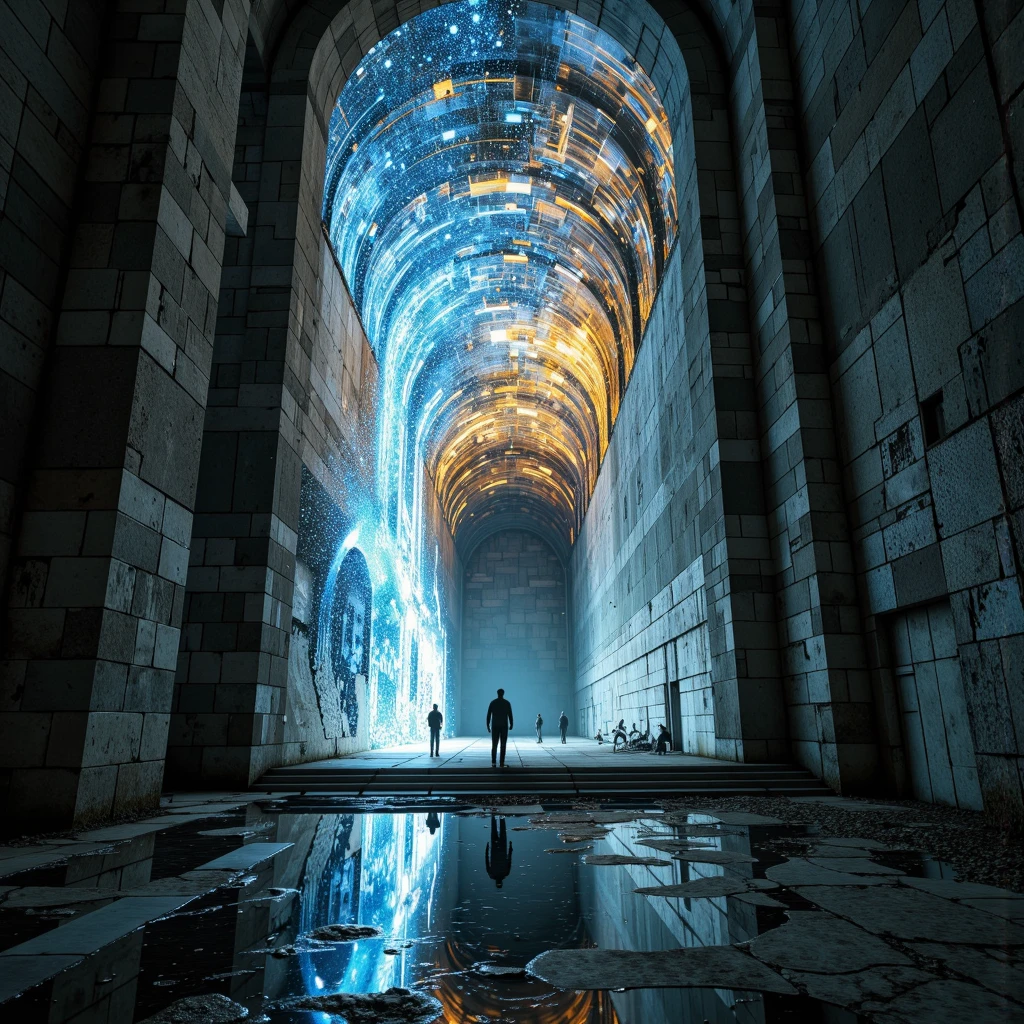
 The transformation of architecture into a digital canvas is no longer just a futuristic vision but a concrete reality manifesting through projects like Refik Anadol’s Data Tunnel in Gorizia. This paradigm shift marks the beginning of a new era where artistic experience transcends traditional physical boundaries to become a multisensory immersion that actively engages the audience. From augmented architecture to virtual reality experiences, we are witnessing a radical redefinition of exhibition spaces and modes of art enjoyment.
The convergence of artistic expression and technological innovation is generating new aesthetic languages and redefining the relationship between creator, work, and user. This essay explores how immersive technologies are transforming the contemporary artistic landscape, creating experiences that blur the boundaries between real and virtual, public and private, creation and consumption.
Augmented Architectures: When Physical Space Becomes a Digital Canvas
Refik Anadol’s Data Tunnel represents an emblematic example of how architecture can be reimagined as a medium for immersive artistic experiences. As highlighted in Source 1, this inaugural project of the Digital Art Gallery in Gorizia transforms physical space into a dynamic canvas through the algorithmic manipulation of data.
Anadol’s approach goes beyond simple projection: it is a true re-signification of architectural space, which becomes an integral part of the artwork. This transformation of exhibition space also finds resonance in the first edition of Art Basel Qatar (Source 3), where the traditional fair experience is rethought in an immersive key.
Wael Shawky’s artistic direction for Art Basel Qatar focuses on a site-specific project aiming to create a “monumental” and transformative experience. In both cases, we witness a surpassing of the traditional conception of exhibition space as a neutral container, in favor of an environment that itself becomes part of the artistic experience.
Digital Identities and Cultural Representation
Parallel to the evolution of exhibition spaces, we are witnessing a transformation in how personal and cultural identity is represented and mediated through new technologies. The MoMA exhibition dedicated to African studio portraits (Source 2) explores how these have contributed to shaping Black identities globally, offering a new vision of freedom and self-determination.
This historical process of identity construction through images finds an interesting contemporary counterpart in the photorealistic avatars developed by Google and Apple (Source 5). Google’s “Likeness” and Apple’s “Personas” represent the digital evolution of the portrait, allowing users to create virtual representations of themselves to interact in digital environments.
The tension between authentic representation and idealized construction of identity, already present in African studio portraits, re-emerges in a new form in these technologies. Furthermore, the collection of 61 works by Matisse donated to the Musée d’Art Moderne de Paris (Source 6), many of which portray his daughter Marguerite, reminds us how the portrait has historically been a powerful means of exploring human relationships and identity.
Immersive Experience as a New Cultural Paradigm
Immersiveness is no longer the sole prerogative of traditional artistic spaces but extends to multiple cultural domains. The immersive Coldplay concert scheduled on Horizon Worlds (Source 7) represents a significant example of how musical experience is evolving towards forms of multisensory engagement that exceed the limits of the traditional live event.
Similarly, SkyjetVR (Source 8) offers a virtual flight experience that transforms gaming into a form of bodily and sensory expression. These new modes of cultural enjoyment are also reflected in institutional events like the 2026 Met Gala (Source 4), which will see figures like Beyoncé, Nicole Kidman, and Venus Williams in the role of co-chairs.
The presence of these celebrities, who operate at the intersection of art, fashion, sport, and entertainment, underscores the growing hybridization of contemporary cultural languages. Art is no longer confined to specific spaces and practices but permeates different areas of human experience, creating unprecedented connections between traditionally separate disciplines.
Towards a Democratization of Artistic Experience?
Immersive technologies promise to make art more accessible and engaging for a wider audience. Projects like Anadol’s Data Tunnel or Coldplay’s virtual concerts offer modes of enjoyment that potentially overcome geographical, economic, and cultural barriers.
However, these technologies also raise critical questions regarding digital accessibility and the potential creation of new forms of exclusion. The hardware required for experiences like SkyjetVR or concerts in Horizon Worlds remains expensive and not universally available.
Furthermore, the growing technological mediation of artistic experience poses questions about the nature of authenticity and the value of direct experience. The paradox is that while these technologies promise greater immersiveness, they also introduce new levels of mediation between the work and the user.
The challenge for cultural institutions and artists will be to use these technologies not merely as tools for spectacularization, but as means to create meaningful experiences that enrich the understanding and appreciation of art.
In this context, the success of initiatives like Art Basel Qatar (Source 3) will depend on their ability to balance technological innovation and artistic substance, creating experiences that are as immersive as they are intellectually stimulating.
The donation of the Matisse collection (Source 6) also reminds us of the importance of preserving and accessing traditional artistic heritage, even as we explore new digital frontiers.
It is in the productive tension between tradition and innovation, between physical and digital, that the contours of the future artistic landscape are being defined.
Immersive art does not replace but rather expands and complements traditional artistic forms, creating a richer and more diversified cultural ecosystem.
Anadol’s Data Tunnel, African portraits at MoMA, Google and Apple avatars, Coldplay’s virtual concerts, and the SkyjetVR experience represent diverse manifestations of this ongoing evolution, which is redefining our relationship with art and culture.
References:
- Come nasce il Data Tunnel che apre la galleria digitale di Gorizia: intervista a Refik Anadol
- MoMA explores how African studio portraits offered a new vision of freedom
- Una fiera immersiva, e trasformativa. Anticipazioni da Art Basel Qatar
- Beyoncé, Nicole Kidman and Venus Williams will co-chair 2026 Met Gala
- Google is Rolling out Photorealistic ‘Likeness’ Avatars on Android XR to Compete with Apple’s ‘Personas’
- Collection of 61 Matisse works—mostly portraying his daughter Marguerite—donated to Paris museum
- Coldplay Immersive Concert Coming to Quest Soon, Music Pack Lands on ‘Beat Saber’ Next Week
- SkyjetVR hands-on: a virtual jetpack for families
This essay was generated using an artificial intelligence workflow designed and supervised by Enzo Gentile. The sources were selected and analyzed automatically, and the final text was critically reviewed before publication.