
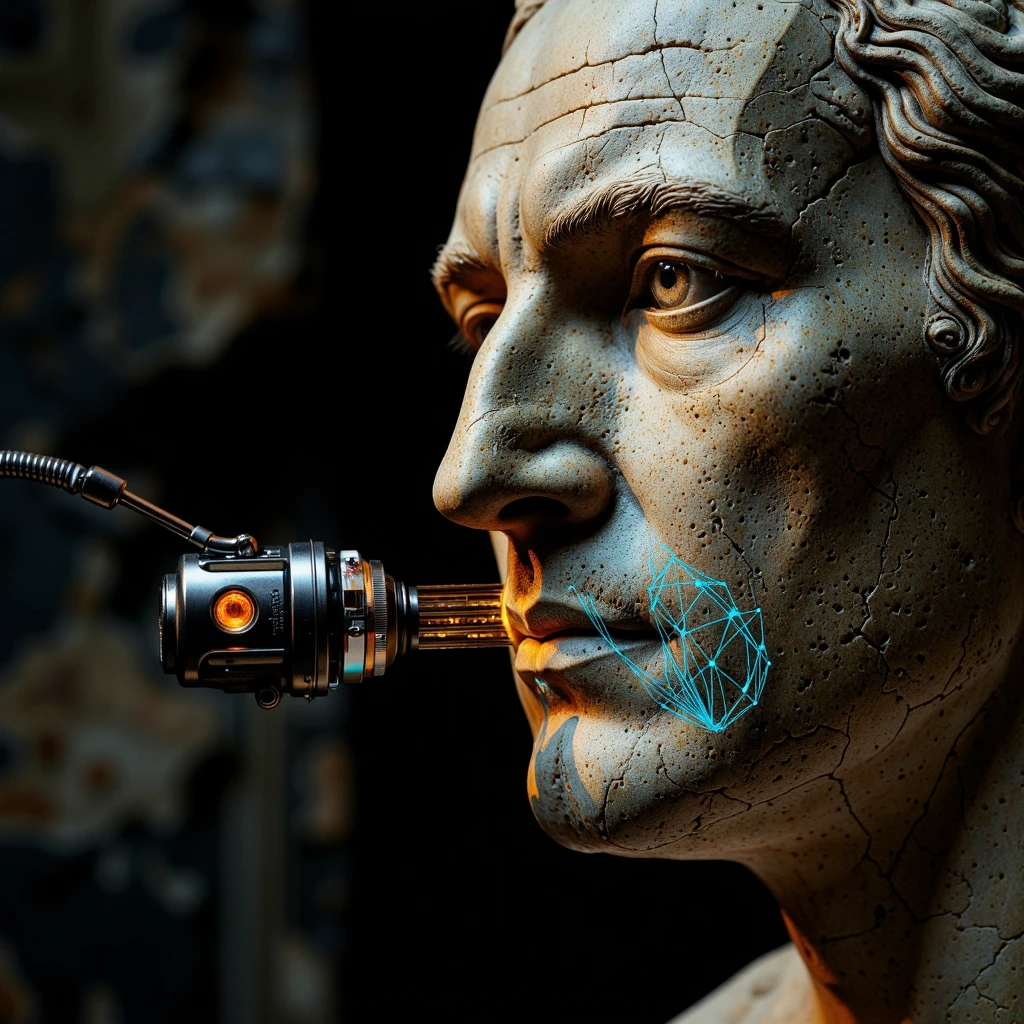
 Rhesus monkeys navigating virtual worlds using only their thoughts represent more than just a scientific experiment—they embody the dissolution of boundaries between mind and machine that is also transforming our relationship with art. The electrodes implanted in the primates by Belgian researchers at KU Leuven (Source 1) raise fundamental questions about the nature of aesthetic experience in the era of brain-computer interfaces.
While technology breaks down neurological barriers, museums and cultural institutions are redefining their physical frontiers. This essay explores how technological innovations are democratizing access to art and culture, creating new spaces of enjoyment that transcend traditional limitations of time, space, and corporeality.
The Mind as a Portal: From Neural Interface to Aesthetic Experience
The KU Leuven experiment with rhesus macaques marks a turning point in BCI (Brain-Computer Interface) research. Three primates, equipped with Utah arrays featuring 96 electrodes implanted in three different brain regions, demonstrated the ability to navigate complex virtual environments with surprisingly little training (Source 1). This breakthrough raises provocative questions: what does access mean when the mind becomes the primary medium of interaction?
In parallel, within the world of digital art, Lucent VR represents one of the most advanced aesthetic experiences available for Quest 3. This virtual destination, technically stunning and artistically inspired (Source 4), demonstrates how virtual reality is evolving from a mere technological tool into a true artistic medium.
The connection between these emerging technologies and aesthetic experience materializes in hardware innovations like the Bigscreen Beyond 2, whose new Halo strap design promises a more comfortable and prolonged immersion in virtual environments (Source 7). Lightness and ergonomics thus become fundamental characteristics to facilitate extended encounters with digital artworks.
Physical Spaces Reimagined: Museums Without Borders
While BCI technology explores the boundaries of the mind, traditional cultural institutions are redefining their physical spaces. The David Geffen Galleries at the Los Angeles County Museum of Art, the result of twenty years of development, proposes itself as a welcoming focal point for the entire Los Angeles area (Source 3). This ‘vast concrete masterpiece’ represents an attempt to democratize access to art through architecture itself.
In Florence, the revelatory exhibition dedicated to Rothko spans three different venues in the cradle city of the Renaissance (Source 2). This multi-spatial approach creates a dialogue not only between the artist’s works but also between distant eras and artistic traditions, generating new interpretive perspectives.
However, the redefinition of exhibition spaces also raises ethical and historical issues. Zurich’s controversial Bührle Collection, recently rehung, includes five paintings by Van Gogh—plus a forgery—two of which could be subject to restitution claims tied to the Nazi era (Source 8). The provenance of the works thus becomes an integral part of their cultural meaning and ethical accessibility.
Digital Democratization: When Art Comes to You
The Virtual Reading Room (VRR) at the National Art Library perhaps represents the most direct example of how technology is tearing down barriers to accessing cultural collections. This innovative service literally brings the library to the user, wherever they are in the world (Source 5). Through live appointments on Microsoft Teams, staff guide virtual visitors through rare and unique materials using high-resolution cameras.
This interactive and flexible approach radically transforms the relationship between the institution and the user. The physical pilgrimage to the temple of culture is no longer necessary; culture itself becomes mobile and accessible. As highlighted in Source 5, users can explore items in real-time, asking staff to turn pages, pause, or zoom in on specific details relevant to their research or interests.
In parallel, the exhibition ‘Generative Codes’ offers a synthetic overview of Paul Neagu’s artistic trajectory, from his early experiments with tactile art to the construction of complex artistic systems articulated through drawing, objects, performative actions, and sculpture (Source 6). This exhibition highlights how even generative and systemic art can be made accessible through interpretative codes that facilitate understanding.
The Future of Cultural Access: Towards a Mind-Machine-Art Synthesis
Emerging technologies like BCI, VR, and remote access services are converging toward a future where the cultural experience could completely transcend physical constraints. Imagine a world where, like the KU Leuven rhesus macaques, we could navigate art collections with just a thought, or where brain-computer interfaces could allow people with physical disabilities to experience movement through virtual galleries.
However, this technological democratization raises crucial questions. While we celebrate the expansion of access, we must consider the implications of the disintermediation of the artistic experience. The direct encounter with a Rothko in Florence (Source 2) offers sensory, contextual, and social dimensions that no virtual reproduction can fully replicate.
Furthermore, as highlighted by the controversial Bührle Collection (Source 8), digital access does not automatically resolve ethical issues related to provenance and cultural ownership. Technology can amplify access, but not necessarily justice or historical reparation.
The true challenge of the future will be to create cultural access systems that leverage the potential of new technologies without sacrificing the depth, context, and ethics of the artistic experience. As the David Geffen Galleries in Los Angeles demonstrates (Source 3), the goal must be to serve the local community while simultaneously creating global access points.
Emerging technologies will not replace the physical experience of art, but will expand it, creating a richer and more inclusive cultural ecosystem where mind, machine, and art exist in a continuous and productive dialogue.
References:
- Monkeys Navigate Virtual Worlds Using Thought Alone in New BCI Study
- The Big Review: Rothko in Florence
- Los Angeles County Museum of Art’s new David Geffen Galleries reframe 6,000 years of history
- Lucent VR Is The Prettiest Quest 3 Experience I’ve Ever Played
- Plot twist: the Library comes to you!
- Generative Codes
- Bigscreen Reveals New Halo Strap Design for ‘Beyond 2’ PC VR Headset, Shipping Starts in June
- Zurich’s controversial Bührle Collection is rehung, including five paintings by Van Gogh—plus one forgery
This essay was generated using an artificial intelligence workflow designed and supervised by Enzo Gentile. The sources were automatically selected and analyzed, and the final text was critically reviewed before publication.