
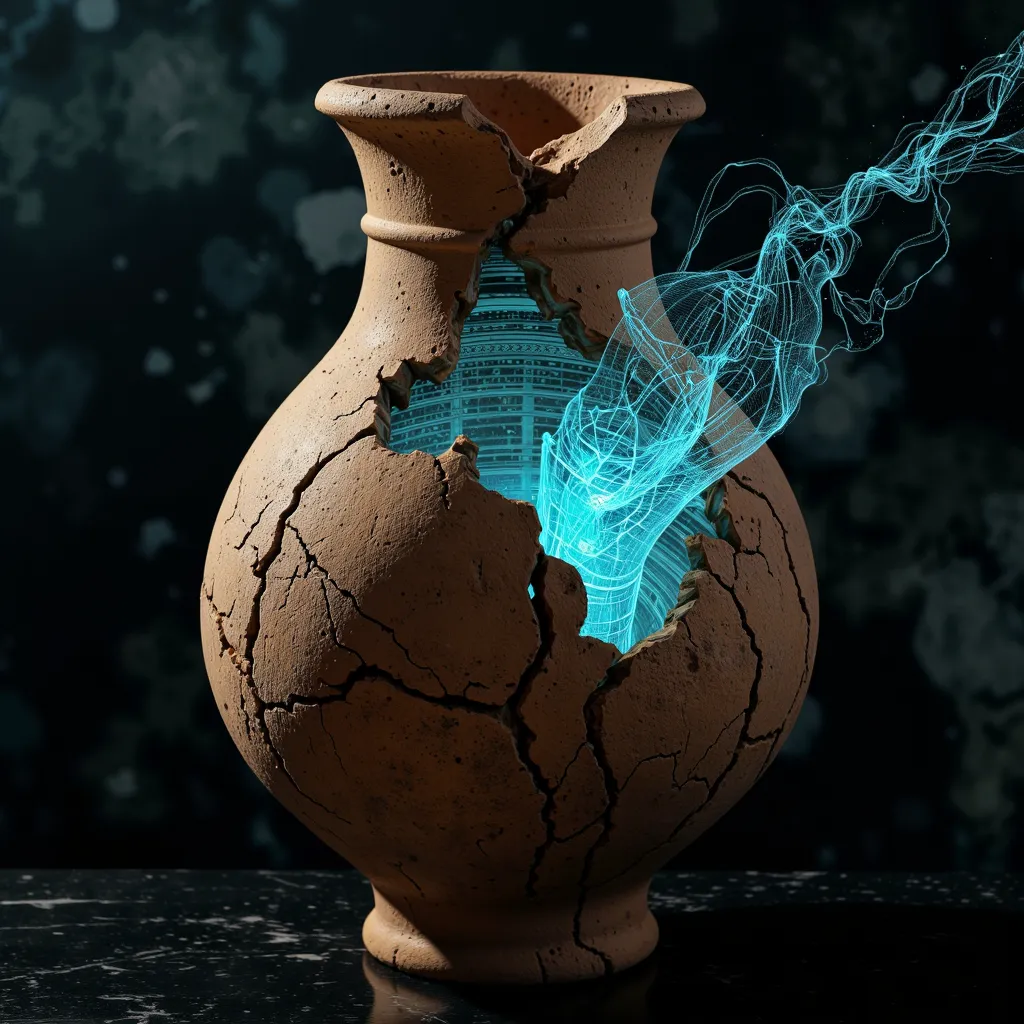
 An algorithm enters an Argentine museum and generates a six-century-old mystery. An Egyptian temple materializes inside a headset. A clay vessel shaped by enslaved hands is juxtaposed with the work of a revolutionary hero. These are fragments of the same radical transformation: the museum is no longer a static container of objects, but an organism that continually rewrites the relationship between past, present, and future.
The thesis running through this essay is precise: the convergence of artificial intelligence, immersive technologies, and new curatorial practices is redefining not only the way we access art but, above all, the very meaning we attribute to cultural objects. And artists, far from being passive spectators, are responding with works that question materiality, scale, and historical memory with renewed urgency.
When the Algorithm Becomes Curator
The case of the Museo Nacional de Bellas Artes in Buenos Aires is emblematic of a trend that mixes commercial provocation with authentic investigation. As recounted by[cite: 1], a beer brand collaborated with the museum to subject its masterpieces to an analysis conducted by artificial intelligence algorithms, generating an enigma that spans six hundred years of art history[cite: 1].
The operation raises uncomfortable questions. Can a computational system reveal connections between works that generations of art historians have missed? And above all: what happens to the interpretive authority of the museum when it is delegated, even partially, to a machine?
The answer is not straightforward. On the one hand, the initiative demonstrates that AI can function as an unprecedented lens, capable of crossing centuries and styles with a speed no human eye could replicate. On the other hand, the involvement of a commercial brand introduces a variable that contaminates the ground of pure research.
However, it would be naive to dismiss the experiment as a mere marketing stunt. The fact that an algorithm can generate a mystery—and not just an answer—suggests that these technologies work best when they amplify questions rather than simplify answers.
The Temple That Travels Beyond the Walls
If in Buenos Aires AI questions collections from the inside, in New York the Metropolitan Museum of Art chooses an opposite strategy: bringing the collections outside the museum. As reported by[cite: 2], the Met is developing an immersive experience that transports the iconic Temple of Dendur onto Quest headsets and the web, making it accessible to anyone, anywhere[cite: 2].
This move marks a point of no return. The temple, donated by Egypt to the United States in 1965 and rebuilt in the famous Sackler Wing, has always been an object tied to a specific physical location. Now it becomes a replicable digital entity, visitable from a bedroom in Tokyo as easily as from a café in Lagos.
Consequently, the very concept of a museum visit fragments. It is no longer a pilgrimage to a sacralized building, but an encounter that can happen in any spatial and temporal context. The crucial question becomes: does the aura of the work—to use the Benjaminian term—survive this digital migration, or does it dissolve in the reproduction?
Making this transition even more concrete are hardware developments like those described in. The Raven Prism, smart glasses with a hot-swappable battery presented at the Augmented World Expo, promise prolonged use throughout the entire day. If such devices were to achieve mass diffusion, immersive art would no longer be confined to short sessions in front of a bulky headset, but would become part of the daily flow of perception.
Indeed, the combination of the Met’s immersive experiences and wearable hardware like the Raven Prism outlines a scenario in which the artistic layer is constantly superimposed on physical reality. Museums, in this near future, would no longer need walls.
Bodies, Stains, and Submerged Narratives
And yet, just as technology dematerializes the artistic experience, some of the most powerful voices in the contemporary art world call us back to the irreducible physicality of objects and bodies. The MFA in Boston, as recounted by, has made an unprecedented curatorial gesture: juxtaposing a clay vessel by David Drake, an enslaved artist, with a silver cup by Paul Revere, a hero of the American Revolution.
The juxtaposition is a political act even before it is an aesthetic one. Two artifacts from the same historical period, produced by hands occupying opposite positions in the hierarchy of power, now sit side by side. The museum thus rewrites its own narrative of American art, admitting that the history celebrated in its halls has always been incomplete.
This urgency to recover submerged memories finds a powerful echo in the words of Ibrahim Mahama. In, the Ghanaian artist—who is recovering from a brutal physical assault—speaks of his commission at Münsterplatz and the need to preserve the memory of objects with complex histories. For Mahama, stains are not imperfections to be erased: they are the very fabric of the narrative. Every sign of wear, every trace of passage, is a document.
Furthermore, the work of Es Devlin at the V&A East Storehouse adds another layer to this reflection. Her installation The Everythingists—which combines sculptural figures, animated lights, music, and voice in dialogue with Natalia Goncharova’s monumental backdrop for The Firebird—explores the relationship between bodies and architecture, between conservation and movement, between human labor and technological progress. Devlin does not oppose the physical to the digital: she intertwines them, demonstrating that technology can amplify bodily presence rather than replace it.
Scale, Color, and Legacy
The question of physicality in art finds a particularly lucid formulation in the words of Anish Kapoor. As emerges from, the artist—on the occasion of his retrospective at the Hayward Gallery—warns against the equation between size and quality: just because a work is monumental does not automatically make it interesting or successful.
It is a warning that resonates strongly in an era when immersive experiences tend to prioritize sensory spectacle over conceptual depth. Kapoor, with his work on the blackest black and the most intense pigments, demonstrates that the materiality of art is not a remnant of the past, but the terrain on which the most radical challenges of perception are still played out.
Finally, the passing of David Hockney at eighty-eight offers an elegiac backdrop to these reflections. The tributes pouring in from figures like Tracey Emin and Nicholas Serota testify to the impact of an artist who traversed half a century of technological transformations—from painting to Polaroid photography, from the iPad to digital paintings—without ever abandoning the conviction that the act of looking at the world with attention is the foundation of every artistic practice.
Hockney did not fear technology, but he never ceded it primacy over the human eye. In this, his legacy dialogues directly with all the tensions running through the present: algorithms that interrogate masterpieces, temples that migrate into headsets, objects that reclaim their own history.
A Threshold, Not a Destination
What emerges from this constellation of events is a certainty: the museum of 2026 is a field of forces where technology, the politics of memory, and artistic research vie for the right to define what it means to preserve, exhibit, and interpret culture.
Artificial intelligence and immersive reality are not neutral tools. They carry with them implicit ideologies—of universal accessibility, of democratization, but also of dematerialization and spectacularization. At the same time, artists like Mahama, Kapoor, and Devlin remind us that the most urgent art still stems from contact with matter, with the body, with the scars of history.
The real challenge is not choosing between physical and digital. It is building cultural institutions capable of holding both dimensions together without one erasing the other. The museum without walls is an extraordinary possibility, provided it does not also become a museum without memory.
References:
- How AI Turned a Museum’s Masterpieces into a 600-Year-Old Mystery – MuseumNext
- The Met’s Immersive Future Extends Beyond The Museum – UploadVR
- Raven Prism Smart Glasses Announced with Unique Hot-swappable Battery – Road to VR
- In museum first, MFA Boston pairs prized vessels by Paul Revere and enslaved artist David Drake – The Art Newspaper
- Ibrahim Mahama: ‘All these things are the stains; they are part of the story’ – The Art Newspaper
- Making East London: An Interview with Es Devlin – V&A Blog
- Anish Kapoor: ‘Just because a thing is big, it doesn’t mean it’s of any interest or even good’ – The Art Newspaper
- The art world honours David Hockney – The Art Newspaper
This essay was generated using an artificial intelligence workflow designed and supervised by Enzo Gentile. The sources were automatically selected and analyzed, and the final text was critically reviewed before publication.