
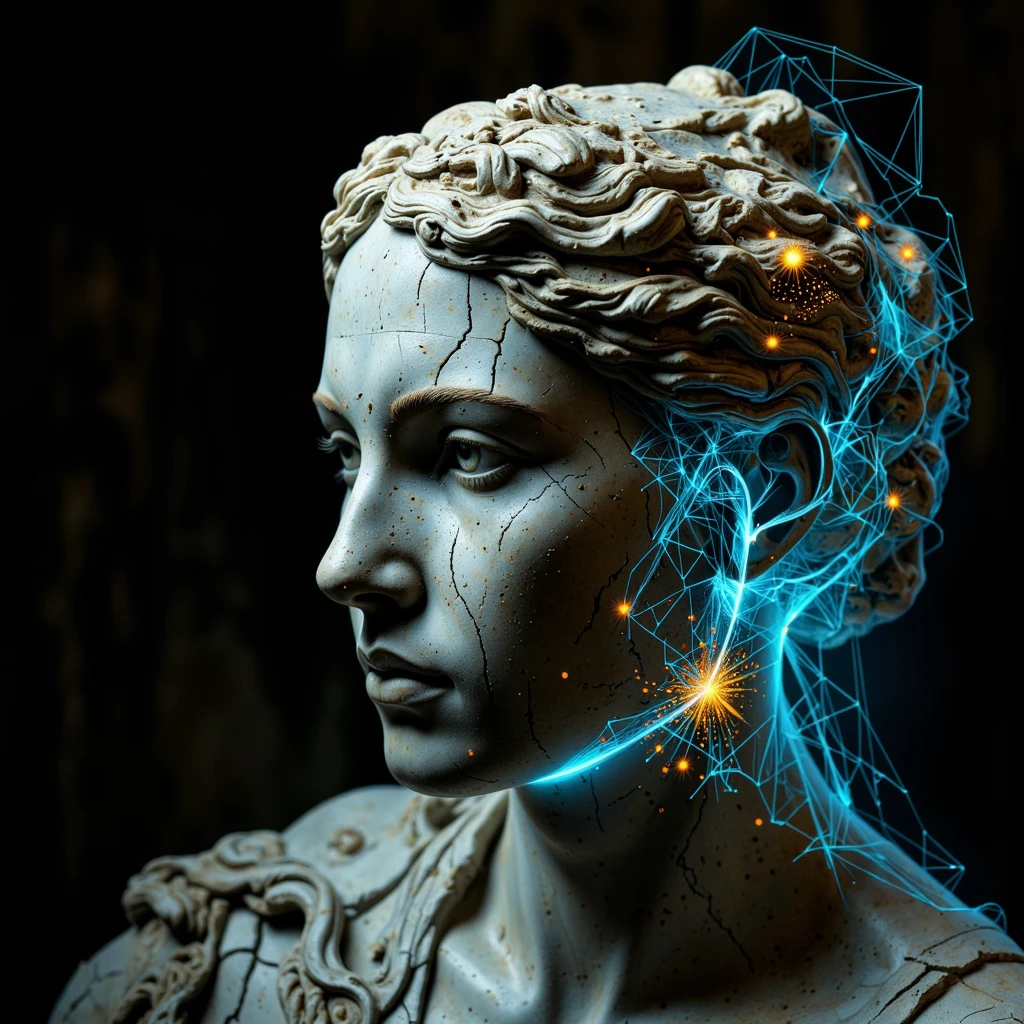
 What does it mean to be human when an algorithm generates images, a 3D printer sculpts clothes, and a posthumous biennale speaks through hybrid beings? The question is not rhetorical: it is the red thread running through the most relevant exhibitions, platforms, and events of this spring 2026. The thesis I intend to develop is that we are witnessing an unprecedented convergence of visionary artistic practices, immersive technologies, and social urgencies, a convergence that redraws the very boundaries of corporeality and perception.
Precognitive Visions: Hilma af Klint and the Body as Threshold
Over a century ago, Hilma af Klint painted what no eye could yet see: cellular structures, energy fields, diagrams of the invisible. The series “What a Human Being Is,” as recalled by[cite: 1], was conceived literally as painting for the future, intended for an audience that did not yet exist[cite: 1].
That faith in the time to come resonates today with unprecedented force. Af Klint did not seek the mimetic representation of the body, but rather its translation into an abstract visual code. In this sense, her work anticipates the logic of contemporary generative art, where the human body becomes a datum, a parameter, a variable of a system.
The crucial difference is that af Klint operated through trance and ritual, while today’s artists delegate part of the creative process to neural networks. However, in both cases, authorship dissolves: the artist becomes a medium—whether spiritual or computational.
Living Matter and Algorithmic Fashion: Iris van Herpen at the Brooklyn Museum
If af Klint translated the body into abstraction, Iris van Herpen takes the opposite path: she transforms algorithmic abstraction into wearable matter. The retrospective “Sculpting the Senses” at the Brooklyn Museum[cite: 2] features dresses made with bubbles, algae, and recycled plastic[cite: 2], proving that sustainable fashion can be radically sculptural.
Van Herpen uses 3D printing and parametric modeling not as technological gimmicks, but as extensions of formal thought. Each dress is an ecosystem: it breathes, deforms, reacts to light. Consequently, the boundary between organism and artifact thins until it disappears.
This approach dialogues directly with the notion of “hybrid beings” running through the 2026 Venice Biennale. The main exhibition, titled “In Minor Keys” and curated posthumously by Koyo Kouoh, relies on sentinel-figures guiding the visitor in a sometimes cacophonous procession. Here, too, the body is a threshold, a bridge between worlds.
Digital as Curatorial Territory: Art Basel and Zero 10
Art Basel has decided to bring the Zero 10 platform to its Swiss edition as well, entrusting the curation to Trevor Paglen alongside Eli Scheinman. The choice is significant: Paglen is an artist who has spent years investigating algorithmic surveillance and the invisible geometries of digital power.
Inserting generative art, artificial intelligence, media art, and net art into the heart of the most prestigious fair in the market means recognizing that these practices are no longer marginal. They are, rather, the gravitational center around which contemporary visual production revolves.
Furthermore, the choice of an artist-curator—rather than an institutional curator—signals a paradigm shift. The artist does not merely produce objects: they organize discourses, build contexts, negotiate visibility. Paglen embodies this dual figure, simultaneously creator and critic of the system.
Extended Reality: From Entertainment to New Perception
In parallel, the virtual and augmented reality sector is accelerating. The XR week of May 2026 announces upcoming news on Android glasses and Valve hardware distribution, while titles like “One More Delve” demonstrate that VR is maturing on the gaming front as well, with physics-based combat and co-op for up to three players.
However, reducing XR to mere entertainment would be short-sighted. When a headset translates bodily movement into digital action, it is effectively reconfiguring proprioception—our sense of position in space. This has profound implications for performative and installation art.
In fact, it is not difficult to imagine a convergence between van Herpen’s sensory sculptures and a mixed-reality environment. Or between Paglen’s geometries and a navigable immersive experience. XR technology offers art a new kind of body: that of the avatar, the digital double, the interactive ghost.
Venice 2026: Resilience, Memory, and Minor Keys
The 2026 Venice Biennale presents itself as a wounded yet vital organism. The death of curator Koyo Kouoh transformed “In Minor Keys” into an act of collective memory. The dedicated podcast reveals a polyphonic exhibition, where artists like Gabrielle Goliath and Lubaina Himid weave stories of resistance and transformation.
The Ukrainian Pinchuk Art Centre brings to Venice fragments of fragile joy extracted from the devastation of war. Once known for worldly parties, today the Kyiv institution chooses narrative sobriety: survival, resilience, care. It is an ethical reversal that questions the entire art system about its responsibility.
Consequently, the Biennale becomes a laboratory where the political body—that of the nation at war, that of the late curator—overlaps with the aesthetic body. The “minor keys” of the title do not indicate weakness, but a deliberate choice of listening, of paying attention to the whisper rather than the scream.
Conclusion: Towards a Post-Corporeal Aesthetic
From af Klint’s spiritist visions to van Herpen’s dress-organisms, from Paglen’s algorithmic curation to the virtual proprioception of XR, up to the wounded corporeality of Venice, a common paradigm emerges: the human body is no longer a stable datum, but a field of forces in constant negotiation.
The most urgent art of this moment does not represent the body—it reconfigures it. It subjects it to technological, ecological, and political pressures, and observes what remains. What remains, perhaps, is precisely that minor key: a residue of humanity that no algorithm can yet simulate, but which every algorithm forces us to redefine.
The challenge for artists, curators, and spectators is to accept this instability as a creative condition, not as a threat. Only in this way can the convergence of art and technology generate meaning rather than mere spectacle.
References:
- “What a Human Being Is” by Hilma af Klint – artXchange Global
- Bubbles, Algae, and Plastics Go Haute Couture in ‘Iris van Herpen: Sculpting the Senses’ – Colossal
- Art Basel punta sul digitale: l’artista Trevor Paglen curerà Zero 10 – Exibart
- One More Delve Impressions – UploadVR
- The XR Week Peek (2026.05.11) – The Ghost Howls
- The Big Review | Venice Biennale 2026: In Minor Keys – The Art Newspaper
- Venice Biennale Special 2026—podcast – The Art Newspaper
- At the Venice Biennale, Ukraine’s Pinchuk Art Centre finds fragile moments of joy amid loss – The Art Newspaper
This essay was generated using an artificial intelligence workflow designed and supervised by Enzo Gentile. The sources were automatically selected and analyzed, and the final text was critically reviewed before publication.