
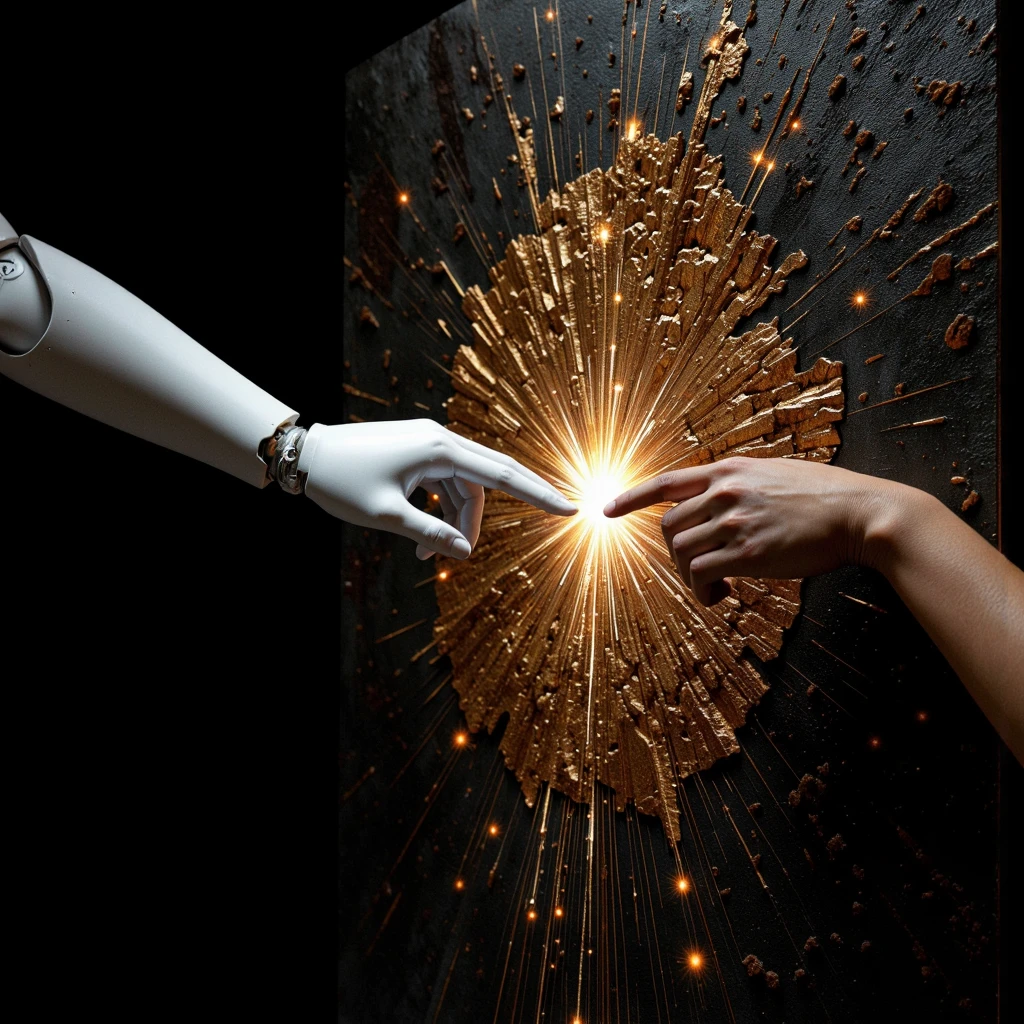
 What happens when the most exclusive art suddenly becomes accessible to anyone? Emerging technologies are radically redefining the relationship between artworks, spectators, and exhibition contexts, democratizing experiences once reserved for a privileged few. From the Apple Vision Pro to tactile sculptures for the blind, we are witnessing an unprecedented phenomenon of openness that raises crucial questions about the future of art consumption.
In this essay, we will explore how new technologies are breaking down physical, economic, and sensory barriers to art access, analyzing the implications of this ongoing revolution for museums, artists, and the public.
Augmented and Virtual Reality: The Ubiquitous Museum
The Museas app for Apple Vision Pro represents a turning point in art consumption. This tool allows users to place artistic masterpieces virtually in their home space, transforming any environment into a personal gallery (Source 1). It is not just about viewing works in digital format, but interacting with them in a completely new way.
This technology raises fundamental questions about the nature of the aesthetic experience. Must the encounter with art necessarily happen in the physical presence of the work? Is the value of the traditional museum experience compromised or enriched?
Concurrently, Meta is preparing to launch two new models of smartglasses that could further revolutionize mobile art consumption (Source 4). These wearable technologies promise to overlay digital content onto everyday reality, potentially transforming any urban space into an open-air gallery.
However, while we celebrate these innovations, a disturbing paradox emerges: the “metaverse”—proclaimed as the future of digital interaction—is repeatedly declared “dead” (Source 4). This contradiction highlights the tension between technological enthusiasm and cultural skepticism that characterizes our era.
Multisensory Art: Beyond Sight
A radically different approach to artistic accessibility comes from the Space Telescope Science Institute, which has created tactile panels of the planet Uranus based on images from the James Webb telescope (Source 3). These tools allow blind or visually impaired people to “see” through touch what would normally only be accessible visually.
The initiative represents an illuminating example of how technology can expand, rather than limit, the sensory experience of art and science. The panels, distributed for free to American museums and educational institutions, demonstrate that accessibility can be integrated into the very design of the cultural experience.
This multisensory approach to art consumption links to the issue raised by the restoration of Donatello’s bronze statue “Gattamelata” (Source 8). While the preservation of the work requires protecting it from the elements, its removal from public space raises questions about the physical accessibility of monumental art.
Human-Machine Collaborations: New Creative Paradigms
Chinese-Canadian artist Sougwen Chung explores the concept of “human-machine creative entanglement” in her artistic practice presented at Art Basel Hong Kong (Source 2). Her work represents not only an innovative use of technology but a redefinition of the creative process itself, where the human artist and technological systems become collaborators.
This collaborative vision contrasts with the dystopian narrative presented in Timur Bekmambetov’s film “Mercy,” which explores the unsettling implications of artificial intelligence and algorithms in contemporary society (Source 5). The film raises crucial questions about power, security, and responsibility in the digital age, highlighting the risks of an unbalanced relationship between humans and technology.
The tension between the creative potential and dystopian risks of technology finds further expression in the work of Xiaoze Xie, who preserves banned books by transforming them into porcelain sculptures (Source 6). This work highlights how technology can be an instrument of both preservation and control of knowledge and artistic expression.
Conclusion: Towards an Aesthetics of Accessibility
Technological innovations are radically transforming the way art is created, distributed, and consumed. From virtual reality to tactile panels, from human-machine collaborations to issues of digital conservation, we are witnessing the emergence of a new paradigm that we could define as the “aesthetics of accessibility.”
This paradigm is not without contradictions and risks. As highlighted by the analyzed sources, technology can democratize access to art but also generate new forms of exclusion; it can preserve works of the past but also threaten traditional practices of consumption.
The challenge for artists, cultural institutions, and the public will be to find a balance that leverages the democratizing potential of new technologies without sacrificing the depth of the aesthetic experience or falling into the dystopian traps highlighted by works like “Mercy.”
In this rapidly evolving scenario, the value of art will no longer reside exclusively in the physical object or its placement in consecrated spaces, but in its capacity to generate meaningful experiences through multiple sensory and technological channels, accessible to an increasingly diverse audience.
References:
- An Immersive Perspective of Artistic Masterpieces in Apple Vision Pro
- ‘The human-machine creative entanglement’: artist Sougwen Chung on her technology-based practice
- Free astronomy tactile panel available for museums, science centers, and more!
- The XR Week Peek (2026.03.30): Meta to launch two new smartglasses, the metaverse dies again and again, and much more!
- Mercy: nel film di Bekmambetov l’apocalisse digitale è alle porte della realtà
- Xiaoze Xie Preserves a Growing Collection of Banned Books in Porcelain
- Matisse’s explosive finale and a new chapter for Hong Kong? Plus, Schiaparelli and Dalí—podcast
- One of Donatello’s most important bronze statues is being restored: should it ever be shown outdoors again?
This essay was generated using an artificial intelligence workflow designed and supervised by Enzo Gentile. The sources were automatically selected and analyzed, and the final text was critically reviewed before publication.