
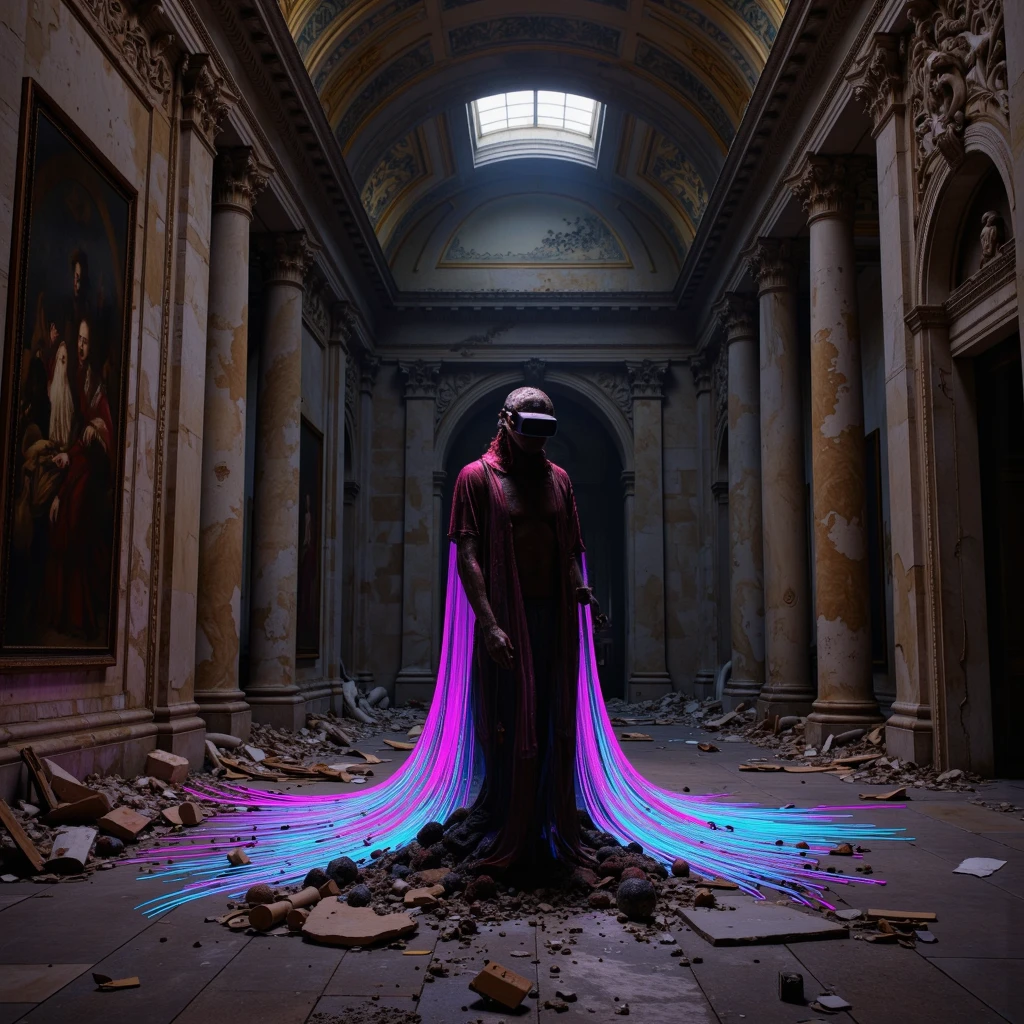
 The encounter between physical space and the virtual dimension is radically redefining the very concept of ‘place’ in the contemporary artistic experience. While traditional museums like the Louvre face structural crises, new forms of immersive consumption are emerging through VR technologies that radically transform the relationship between the audience, the work, and the space. This tension between physicality and virtuality does not represent a simple technological evolution, but a profound transformation of artistic language and its cultural geography.
The Virtualization of Narrative Experience
The dystopian series Black Mirror is about to materialize in a physical dimension through a location-based VR experience debuting in Montreal (Source 1). This project, developed by Univrse and Banijay Live Studio, represents a significant evolution in transmedia storytelling.
The peculiarity of this installation lies in the fusion of physical environments and VR headsets, creating what we might call a ‘collective augmented reality’ where the technological dystopia of the series becomes tangible for visitors.
In parallel, the video game universe of Cyberpunk 2077 is also about to transform into a large-scale VR experience thanks to the collaboration between CD Projekt Red and Zero Latency VR (Source 3). These projects signal an important trend: dystopian narrative is leaving the screen to be embodied in physical spaces through technological mediation.
The critical dimension of Black Mirror toward technology is paradoxically amplified through technology itself, creating a meta-commentary on the contemporary immersive experience.
The Persistent Centrality of Physical Space in Traditional Art
While VR experiences redefine the concept of place, the world of traditional art continues to deeply value geographic specificity. The choice of the Gagosian gallery to present three important late paintings by Francis Bacon in Paris underscores the artist’s profound bond with the French capital (Source 2).
This curatorial decision highlights how the relationship between artist and place remains a fundamental element in traditional artistic narrative, resisting digital deterritorialization.
The acquisition by the Art Institute of Chicago of the work “The Dugout” by Norman Rockwell (Source 5) also reinforces this sentimental geography of art. The painting, depicting Chicago Cubs players, establishes a cultural and identity-based link with the city that hosts it.
Milan, meanwhile, consolidates its position as a contemporary art hub with the arrival of the Paris fiera Internationale (Source 4), demonstrating how the physical geography of artistic institutions continues to reconfigure itself according to dynamics of global competition.
Crisis and Transformation of Museum Institutions
While new immersive experiences thrive, traditional museum institutions face existential challenges. The Louvre, under the new direction of Christophe Leribault, finds itself dealing with a “dilapidated” infrastructure and the consequences of a devastating theft (Source 7).
This crisis of the most visited museum in the world raises questions about the sustainability of the traditional museum model in the digital age. In parallel, the debate over the introduction of fees for tourists in English museums (Source 8) highlights the economic tensions running through these institutions.
The situation of the Louvre represents an emblematic case of how prestigious cultural institutions are called to reinvent themselves in the face of contemporary challenges, balancing heritage conservation and innovation in the visitor experience.
In this context, artist Ali Cherri has filed a war crimes complaint in France regarding an Israeli airstrike in Beirut that killed his parents (Source 6), demonstrating how art continues to intertwine with issues of justice and historical memory, even in the era of virtualization.
Towards a Hybrid Geography of Artistic Experience
The analysis of various sources suggests the emergence of a new geography of artistic experience characterized by an increasing hybridization between physical and virtual. We are not witnessing the simple replacement of one paradigm with another, but their complex integration.
The VR experiences of Black Mirror and Cyberpunk 2077 do not cancel out the specificity of place but reinterpret it through technology, creating augmented spaces where the narrative can unfold in unprecedented forms.
At the same time, traditional artistic institutions are called to rethink their role and infrastructure, integrating elements of digitalization without losing the connection to the territory and the materiality of the works.
The challenge for the future of art seems to lie precisely in the ability to navigate this productive tension between physical rooting and the potential for deterritorialization offered by new technologies.
As the Black Mirror VR experience demonstrates, the critique of technology can paradoxically find in technology itself a powerful expressive tool, creating a conceptual short circuit that enriches the artistic experience.
Conclusion
The geography of contemporary artistic experience is increasingly taking the form of an archipelago of physical, virtual, and hybrid spaces, interconnected yet endowed with their own specificities. Location-based VR experiences represent the avant-garde of this transformation, but they do not replace the value of geographic specificity in traditional art.
The future of art seems to be moving toward a dynamic coexistence between these different modes of consumption, where technological innovation intertwines with the persistent relevance of the physical place and its history.
In this complex geography, artistic institutions are called to profoundly rethink their role, balancing conservation and innovation, global accessibility and local rooting, in a constant dialogue with the new possibilities offered by technology.
References:
- ‘Black Mirror’ to Bring Show’s Tech Dystopia to Life in New Location-based VR Experience
- Gagosian chooses Paris location to present three important late paintings by Francis Bacon
- Cyberpunk 2077 Experience Coming To Zero Latency VR Locations
- Milan’s contemporary art credentials further bolstered by arrival of Paris Internationale
- Art Institute of Chicago’s first Norman Rockwell acquisition is a home run
- Artist Ali Cherri files war crimes complaint in France over Israeli airstrike in Beirut that killed his parents
- The Louvre’s new director is inheriting a troubled, traumatised museum—can he repair the damage?
- Should English museums charge tourists? Plus, Raphael at the Met and Senga Nengudi at the Whitechapel Gallery—podcast
This essay was generated using an artificial intelligence workflow designed and supervised by Enzo Gentile. The sources were automatically selected and analyzed, and the final text was critically reviewed before publication.