
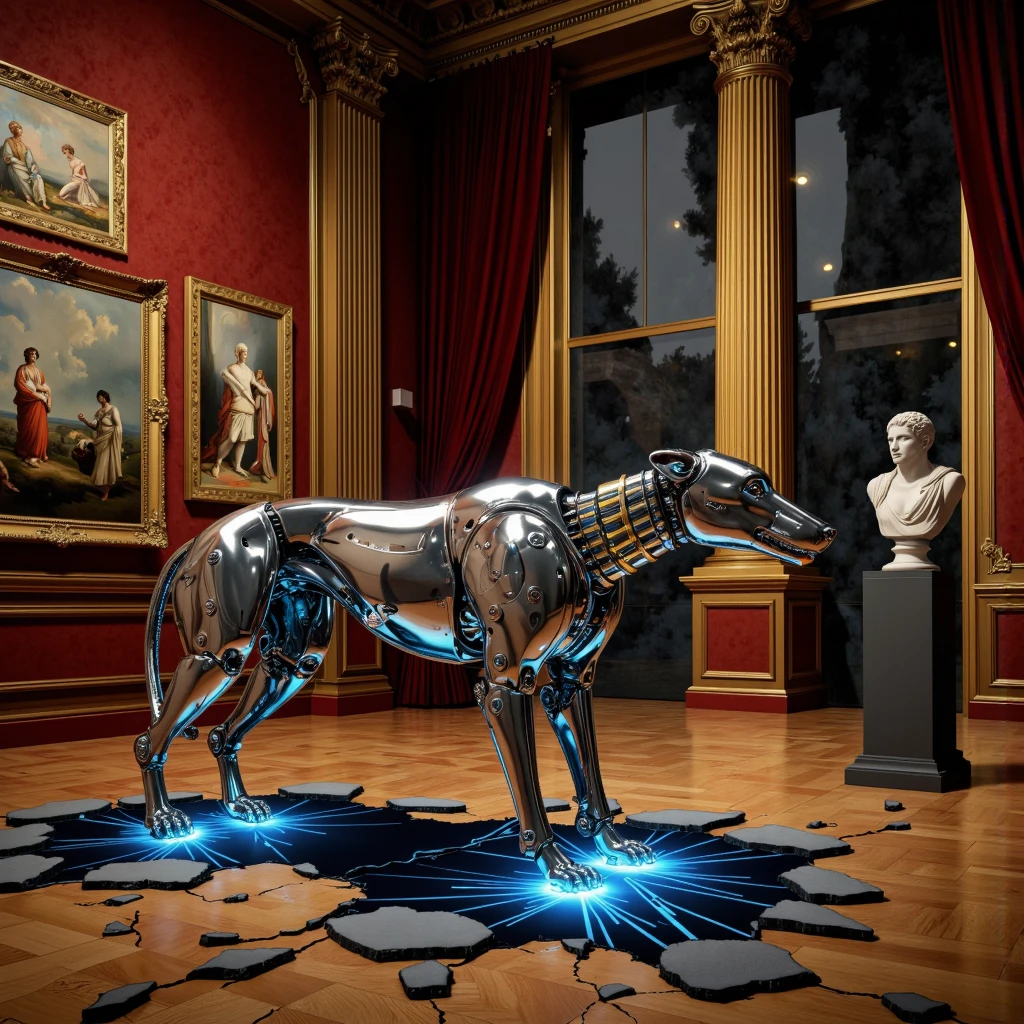
 Beeple’s robotic dogs with hyper-realistic tech mogul heads wag their tails among the booths at Art Basel Miami Beach, while virtual reality jetpacks and smart contact lenses are presented in Brussels. We are facing a crucial crossroads in the contemporary art world: technology is creating an increasingly evident fracture between traditional forms of expression and digital innovations.
This dichotomy is also reflected in market dynamics, where digital art and classic works seem to follow parallel but distinct trajectories, revealing a rapidly evolving artistic ecosystem that requires new interpretative keys.
Zero 10: When Digital Art Conquers Traditional Fairs
Art Basel Miami Beach inaugurated a section entirely dedicated to digital art this year, named Zero 10. Among the most discussed installations is that of artist Beeple, who presents robotic creatures with hyper-realistic heads resembling important figures from the tech world (Source 1).
This new section represents an important institutional recognition for digital art, signaling how traditional fairs are trying to integrate new expressive forms into their format.
However, as highlighted in Source 7, this expansion coincides with a return to the secondary market for more consolidated works, suggesting that the art market is going through an adaptation phase that could lead to a true bifurcation.
Indeed, while Beeple’s installation attracts visitors’ attention, a museum simultaneously acquires an imposing triptych by Martin Wong, a traditional work publicly exhibited only once previously (Source 8).
The Algorithm as a New Aesthetic Canon
Andrea Crespi’s exhibition Artificial Beauty at Fabbrica del Vapore explores the dialogue between human and machine in defining the concept of beauty. The artist investigates how algorithms are redefining our aesthetic parameters, transforming beauty into a computational formula (Source 5).
This research fits into a broader context where technology is no longer just a tool but becomes a co-creator of the artwork. Algorithmic beauty represents an evolution of the very concept of aesthetics, where the boundaries between human creation and automated generation become increasingly blurred.
This approach connects to reflections on virtual space in video games, where the visual development artist defines volumes and rhythms before final modeling, in a process that unites architecture, perception, and game design (Source 3).
In this context, the artist often remains behind the scenes, ceding part of the creative process to technological tools that contribute to defining the final aesthetic experience.
XR and New Frontiers of Artistic Experience
While the art world debates its digital identity, the XR industry continues to develop technologies that could radically redefine the artistic experience. The United XR Europe event in Brussels presents innovations such as VR jetpacks, super-wide field of view headsets, and smart contact lenses (Source 2).
These technologies open up unprecedented scenarios for art enjoyment, potentially transforming the relationship between work, space, and spectator. However, contrasting signals are not lacking: Meta, one of the main players in the sector, is divesting from mixed reality while still declaring itself committed to the future (Source 6).
This strategic oscillation reflects the uncertainties of a market in definition, where creative potential clashes with challenges of adoption and economic sustainability.
The Dialogue Between Tradition and Innovation
In this landscape of rapid technological evolution, a renewed interest also emerges for historical figures who challenged the conventions of their time. The rediscovery of Michaelina Wautier, an innovative and mysterious Flemish painter, at the Kunsthistorisches Museum in Vienna (Source 4), offers an interesting parallel with contemporary challenges.
Just as Wautier broke the molds of her time, today’s digital artists are redefining the boundaries of art, often facing similar resistance from traditional institutions.
This dialogue between past and present, between established techniques and digital experimentation, perhaps represents the key to understanding the current moment of transition in the art world.
The coexistence of Beeple’s robotic dogs and Martin Wong’s triptychs at the same fair is not a contradiction, but the symptom of an artistic ecosystem that is expanding its boundaries without necessarily abandoning its roots.
Ultimately, the bifurcation of the art market between digital and traditional does not necessarily imply a rupture, but rather a broadening of the expressive and commercial possibilities that characterize the contemporary landscape.
References:
- Who let the dogs out? Beeple unleashes uncanny robot canines at Art Basel Miami Beach
- A preview of United XR Europe: a VR jetpack, super-wide-FOV VR, smart contact lenses, and more!
- Inside virtual worlds. Here is how video game architecture is built
- Vienna rediscovers Michaelina Wautier, an innovative and mysterious artist
- When beauty becomes an algorithm. Andrea Crespi at Fabbrica del Vapore
- The XR Week Peek (2025.12.08): Meta disinvests in MR but is still committed for the future, and more!
- New tech and old names drive sales at Art Basel Miami Beach
- Museum acquires massive Martin Wong triptych from Art Basel Miami Beach
This essay was generated using an artificial intelligence workflow designed and supervised by Enzo Gentile. The sources were selected and analyzed automatically, and the final text was critically reviewed before publication.