
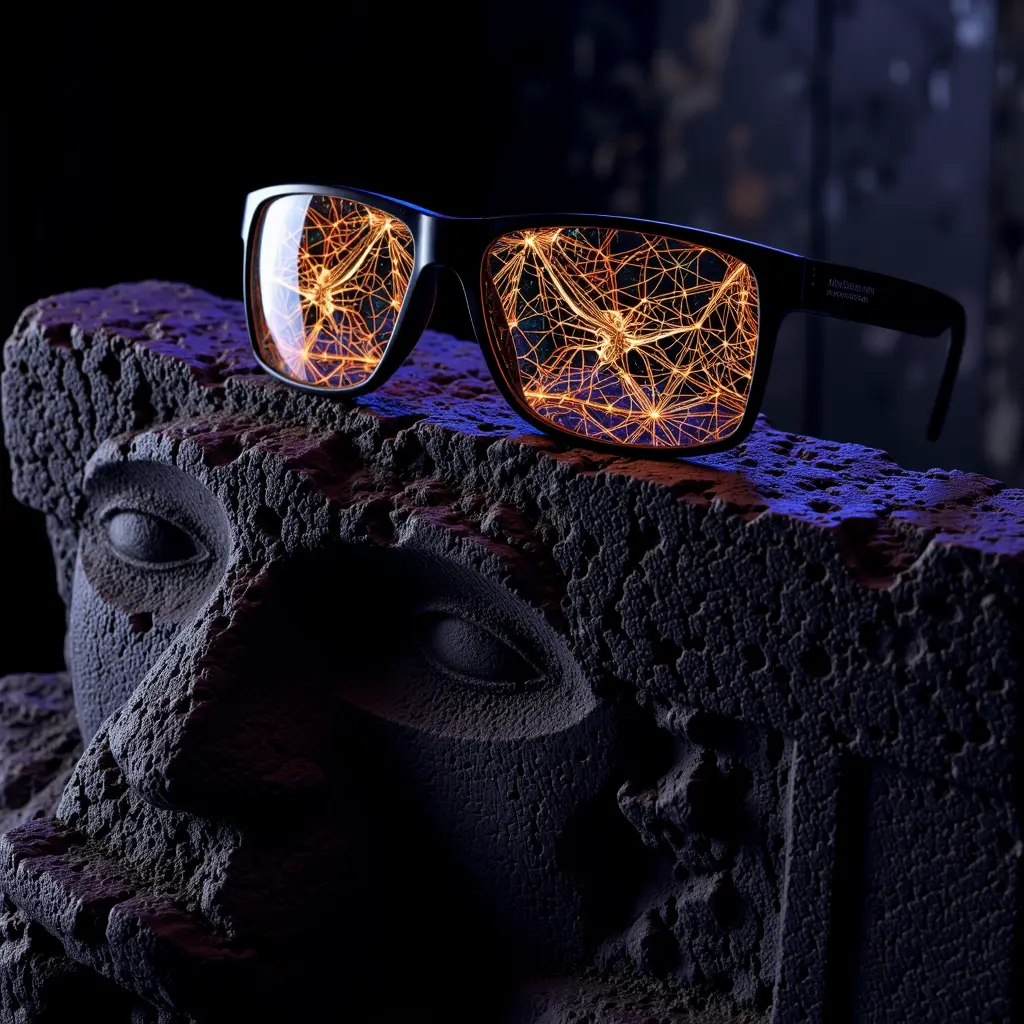
 What happens when a haute couture dress breathes like an organism, an alpine garden becomes a political manifesto, and a pair of glasses promises to overwrite what we see? It happens that the boundaries between body, nature, and machine dissolve—and art finds itself at the exact center of this dissolution. The thesis I intend to develop is precise: the most significant artistic practices of 2026 share a common impulse, that of merging once-separated dimensions—the physical and the digital, the artisanal and the algorithmic, the local and the global—not to celebrate technological progress per se, but to question the fragility of living structures, be they ecosystems, communities, or the human body itself. From augmented reality to stop-motion animation, from biomimetic couture to disputes over the restitution of millennial artifacts, a red thread emerges that deserves to be followed to the end.
The Body as a Contested Territory
Iris van Herpen has brought an exhibition to the Brooklyn Museum in New York that does not merely display clothes: it transforms them into organic architectures where garment, body, and space interpenetrate until they become indistinguishable. The Dutch couturière blends 3D printing, laser cutting, and biocompatible materials with a sculptural sensibility more reminiscent of contemporary art than the runway.
This hybrid approach reveals something profound. The body is no longer a mere support for the fabric: it is an ecosystem in dialogue with technology and nature, a place where the forces of computational design meet the vulnerability of the skin.
In Vienna, Marianna Simnett pushes this reflection into a more disturbing territory. The British artist stated that “entertainment is often violence shrouded in a fun disguise,” and her practice—which includes prolonged tickling sessions and Botox injections into her vocal cords—explores the fine line between pleasure and coercion. Her stated goal is “to create the right amount of openness for other people to be open as well.”
However, where van Herpen celebrates the harmonious fusion of body and technology, Simnett exposes its violent potential. Both, however, treat the body as a cultural battlefield: a place where consent, transformation, and identity are negotiated.
Gardens of the Future and Memories of the Past
If the body is the first territory to question, the landscape is the second. The tenth edition of the Biennale Gherdëina in the Dolomites chose the theme “(Future) Paradise Gardens,” transforming fragile—or entirely absent—ecosystems into symbols of survival, love, and possible justice. The garden, here, is not a decorative idyll but a political space: a terrain at once tender and turbulent where our ability to imagine a fairer tomorrow is measured.
This tension between memory and future also resonates strongly in the dispute between Guatemala and Mexico over a stone lintel carved by the Maya artist Mayuy over a thousand years ago. Dubbed “the Michelangelo of the pre-Columbian era,” Mayuy left behind a rare work that is now the subject of intersecting national claims following its restitution to Mexico.
The case raises a crucial question: who owns an artifact when modern political boundaries did not exist at the time of its creation? Consequently, cultural restitution reveals itself to be a garden just as fragile as those of the Biennale Gherdëina—a terrain where good intentions and historical complexity intertwine with no easy solutions.
Furthermore, at the Nasher Museum at Duke University, the group exhibition Everything Now All At Once brings together dozens of works by artists such as Nick Cave, Ai Weiwei, Nina Chanel Abney, and Wangechi Mutu to celebrate diversity, resilience, and joy. The curatorial choice to juxtapose such diverse voices in a single exhibition space reflects the same impulse as the Biennale Gherdëina: to build symbolic ecosystems where plurality is not a problem to be managed, but a wealth to be cultivated.
When Technology Rewrites Vision
While museums and biennales redefine the physical space of art, the tech industry works to redefine perception itself. The South Korean startup LetinAR, backed by LG, raised $18.5 million to accelerate the commercialization of its augmented reality optics, with an IPO planned for next year[cite: 1]. The goal is to produce lightweight, high-performance AR lenses on an industrial scale.
In parallel, Meta announced its Connect event for September 23-24, teasing a new pair of smart glasses and confirming the focus will be on VR, wearables, the metaverse, and artificial intelligence. The entire XR sector is watching closely to understand market direction.
These developments are not mere industry news: they represent the material infrastructure of a perceptual transformation. Indeed, if LetinAR and Meta succeed in making AR glasses an everyday item, the overlap between real and digital will become permanent. Art will have to confront viewers whose visual field is already stratified, already augmented.
Yet, precisely here the most fertile paradox emerges. LAIKA Studios, with the film Wildwood coming out in October, proves that the opposite direction is equally powerful: the studio combines handmade elements with cutting-edge technology to create an animated world that values artisanal materiality[cite: 2]. Where augmented reality dematerializes experience, LAIKA re-materializes it, insisting on the physical grain of puppets and sets built atom by atom.
Consequently, the comparison between these two trajectories—AR adding digital layers to the world and stop-motion animation celebrating matter—illuminates a fundamental dialectic of our cultural moment.
Conclusion: Cultivating Complexity
The red thread running through all these stories is the productive tension between fragility and ambition. The gardens of the Biennale Gherdëina are as fragile as the ecosystems they represent. The body in Simnett’s hands is as vulnerable as the one wrapped in van Herpen’s textile architectures. The Maya cultural heritage is contested because it is precious and unrepeatable. The diversity celebrated at the Nasher Museum exists precisely because it is threatened.
At the same time, LetinAR’s AR optics and Meta’s smart glasses promise to add new layers to reality, while LAIKA demonstrates that the resistance of matter is also a form of innovation[cite: 1, 2]. The most vibrant art of 2026 does not choose between analog and digital, between local and global. Rather, it inhabits the threshold between these dimensions, cultivating complexity as a gardener cultivates difficult terrain: with patience, awareness, and the certainty that every ecosystem—cultural, technological, human—deserves care.
References:
- LG-Backed AR Lens Startup LetinAR Raises $18.5M Ahead of Planned IPO Next Year – Road to VR
- Glimpse the Fantastical Animated World of ‘Wildwood’ – Colossal
- Nasher Museum’s ‘Everything Now All At Once’ Celebrates Diversity, Resilience, and Joy – Colossal
- Biennale Gherdëina 10: (Future) Paradise Gardens – Digicult
- Garment, body and space merge in Iris van Herpen’s first major New York show – The Art Newspaper
- Meta Connect Event Set for September 23–24 Alongside New Glasses Tease – Road to VR
- Marianna Simnett on being tickled for hours and having Botox injected into her throat – The Art Newspaper
- Guatemala stakes claim to stone lintel by ‘the Michelangelo of the pre-Columbian era’ – The Art Newspaper
This essay was generated using an artificial intelligence workflow designed and supervised by Enzo Gentile. The sources were automatically selected and analyzed, and the final text was critically reviewed before publication.