
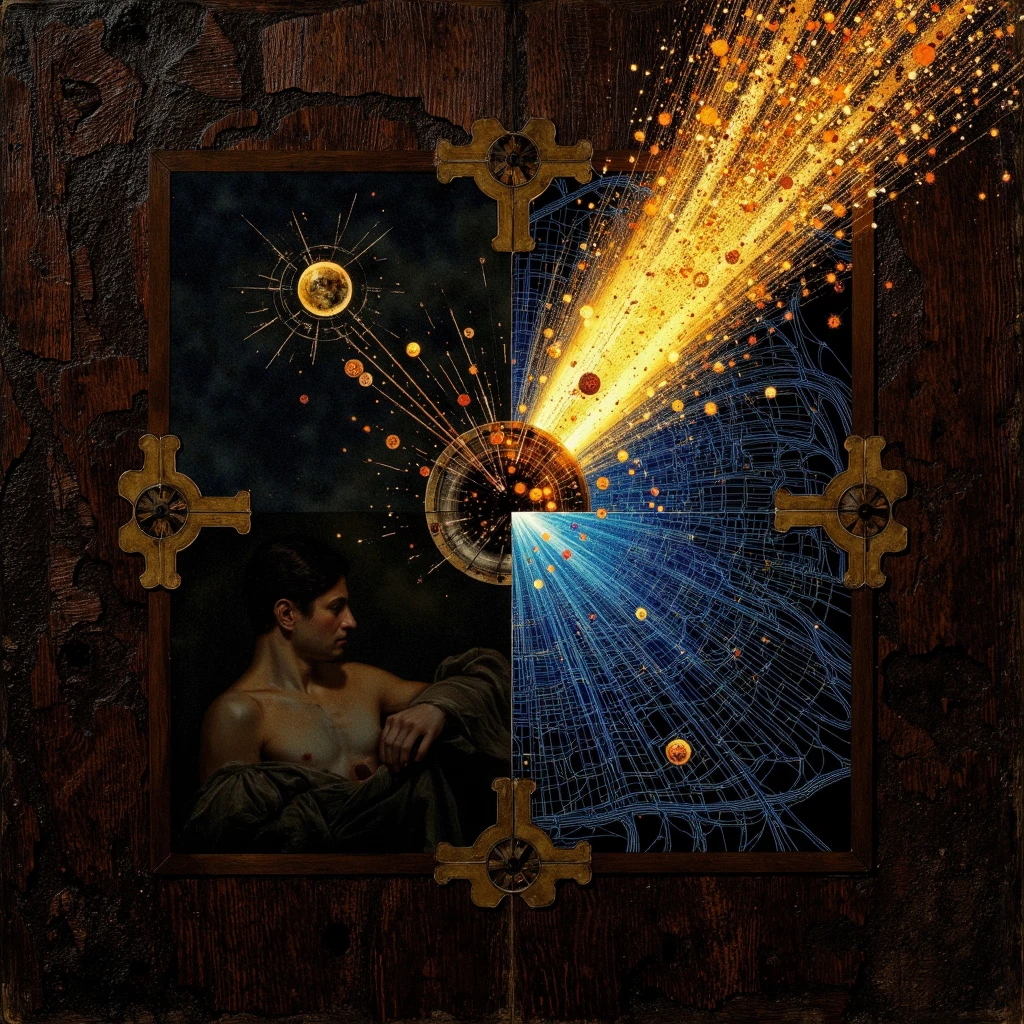
 The digital eye and the human eye meet in increasingly hybrid territories. While a Renaissance masterpiece like Antonello da Messina’s Ecce Homo prepares to change hands at Sotheby’s auction, new technologies like ArtQuest VR allow for virtually exploring artworks with previously impossible detail. This apparent contrast between ancient and futuristic raises a crucial question: how are our modes of perception and interaction with art changing in the era of immersive interfaces?
The answer lies in the analysis of how technology, the art market, and philosophical reflection are converging towards a redefinition of the very concept of artistic experience and, ultimately, of humanity.
Virtual Materiality: New Exhibition Spaces
ArtQuest VR represents a turning point in how we can approach works of art. As highlighted in Source 1, this platform allows observing microscopic details of paintings, overcoming the physical limitations of traditional museums where works are often protected by glass and safety distances.
This transformation of the museum experience raises questions about the very nature of artistic fruition. Would the value of contemplating Antonello da Messina’s Ecce Homo (Source 2) through a VR headset be comparable to the experience of observing it in person? The question is not merely technical, but ontological.
Indeed, technology does not limit itself to replicating the physical experience, but expands it. The possibility of simultaneously observing both sides of a painted panel like the Ecce Homo, visualizing the “recto” and “verso” of the work at the same time, offers perspectives impossible in material reality.
In parallel, the evolution of XREAL‘s AR glasses, which recently raised 100 million dollars (Source 4), suggests that we are moving towards devices that are increasingly less invasive and more integrated into our daily lives. The frontier of the 70° field of view reached by Lumus (Source 7) marks a further step towards increasingly natural digital visual experiences.
Art as Resistance: From Identity to Censorship
In this rapidly evolving technological landscape, art continues to play its role of resistance and provocation. Ai Weiwei‘s first solo exhibition in India (Source 5) takes on particular relevance in a context of growing censorship, demonstrating how artistic expression remains a tool of intellectual freedom.
Ai Weiwei’s work reminds us that, despite technological advancement, political and social tensions persist which art continues to highlight. This critical function of art finds an echo in the contemporary re-reading of Jacques-Louis David at the Louvre (Source 8), where the French artist is re-presented not only as a neoclassicist but as a realist and idealist, capable of dialoguing with the tensions of his time.
Technology, in this context, can become both a tool of control and liberation. As suggested by the reflection on Philip K. Dick (Source 3), the distinction between human and android becomes increasingly blurred in the era of Artificial Intelligence. The question “who is the android today?” assumes relevance not only philosophical but practical in a world where interfaces like VR headsets and AR glasses increasingly mediate our perception of reality.
The Archaeology of the Digital Future
The reflection on the Nabaztag presented by the V&A Museum (Source 6) introduces a crucial element: the archaeology of digital devices. These objects, rapidly obsolete but culturally significant, represent fundamental stages in our relationship with technology.
The Nabaztag, like the first iPhone or the Amazon Echo, are not simple gadgets but artifacts that have shaped social behaviors and cultural perceptions. Their presence in museum collections marks a shift in how we conceive contemporary cultural heritage.
This archaeological perspective invites us to consider even current immersive technologies like ArtQuest VR or XREAL glasses not only as momentary innovations, but as possible artifacts of a future museum of digital culture.
The parallel with Antonello da Messina’s Ecce Homo becomes illuminating: both are artifacts that tell of their time through specific technologies – pigments and wood panel in the 15th century, pixels and algorithms in the 21st.
The Amplified Human Experience
Immersive technologies are redefining not only how we consume art, but also how we conceive human experience itself. Philip K. Dick’s lesson (Source 3) becomes particularly relevant: the distinction between real and artificial becomes increasingly blurred.
In this scenario, art – both classic and contemporary – maintains a fundamental role in prompting reflections on the human condition. The retrospective of Jacques-Louis David (Source 8) and Ai Weiwei’s exhibition (Source 5) represent two complementary modes of this function: re-reading the past to understand the present and using contemporary languages to challenge conventions.
Immersive interfaces like ArtQuest VR do not replace these experiences, but amplify them, creating new spaces of dialogue between work, artist, and viewer. Technology, in this perspective, is not antagonistic to the human but its extension.
The increasing sophistication of AR glasses, with the expansion of the field of view to 70° (Source 7), suggests that soon the distinction between augmented reality and everyday reality will become increasingly less perceptible, leading us towards a continuous hybrid experience.
Conclusion
The intersection of art and technology is not just a contemporary phenomenon, but a continuous historical process that today accelerates exponentially. From the Renaissance Ecce Homo to the virtual spaces of ArtQuest VR, from Ai Weiwei’s activism to the latest generation AR glasses, we are witnessing not the replacement of human experience, but its expansion.
The challenge for museums, artists, and technological developers will be to find ways that do not trivialize the artistic experience, but enhance its depth. At the same time, as suggested by the reflection on Philip K. Dick, we will have to continuously redefine what it means to be human in a world of increasingly invisible and pervasive interfaces.
In this scenario, art maintains its fundamental role: not only as content to be digitized, but as a space of resistance, reflection, and continuous redefinition of the human in dialogue with technology.
References:
- Hands-On: ArtQuest VR Explores What Makes A Good Museum
- L’Ecce Homo di Antonello da Messina sarà battuto all’asta da Sotheby’s
- Chi è oggi l’androide? La lezione di Philip Dick ci aiuta a interpretare l’umanità
- Google’s Leading AR Glasses Partner XREAL Raises $100M
- Ai Weiwei’s first India solo exhibition to open in New Delhi
- Going down the rabbit hole: revisiting the Nabaztag
- Meta Waveguide Provider Claims “world’s first” 70° FoV Waveguide
- The Big Review | Jacques-Louis David at the Musée du Louvre, Paris ★★★★★
This essay was generated using an artificial intelligence workflow designed and supervised by Enzo Gentile. The sources were automatically selected and analyzed, and the final text was critically reviewed before publication.