
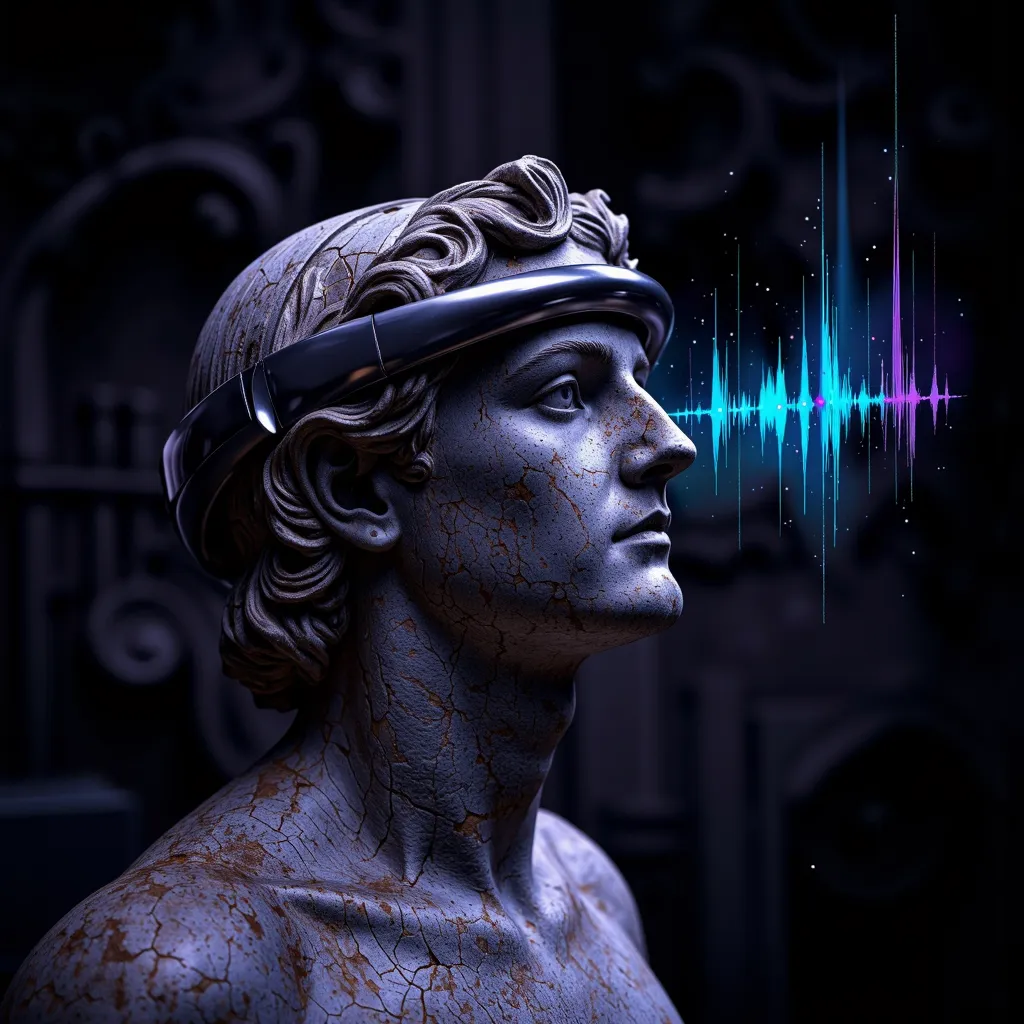
 A Van Gogh painting telling you why you are made for each other. A London transport poster answering your questions as if it were alive. Leonardo’s manuscripts virtually reassembled after four centuries of dispersal. These are three different scenes of the same phenomenon: the museum is learning to speak, and it is doing so with a voice it never possessed before.
The thesis this essay intends to develop is that the convergence of conversational artificial intelligence, digital archives, and new mixed reality devices is redefining the very concept of the museum experience. It is no longer just about digitizing collections or adding interactive screens. The change is deeper: cultural institutions are becoming active interlocutors, capable of building personalized relationships with every single visitor. However, this transformation raises crucial questions about intellectual property, the authenticity of the encounter with art, and the role that the physical body continues to play in the exhibition space.
Reconstructing Memory: Leonardo and the Museo Dolores Olmedo
The Leonardotheka project, led by the Museo Galileo, represents an exemplary case of how digital technology can heal historical fractures. For the first time in four centuries, Leonardo da Vinci’s dispersed manuscripts are reassembled in a single virtual archive, restoring a unified vision of Vinci’s thought that material history had fragmented[cite: 1].
What makes the project particularly significant is not only its philological ambition. The director of the Museo Galileo emphasized that Leonardotheka establishes a “compelling precedent” for how cultural institutions must maintain intellectual property over their digital initiatives[cite: 1]. It is a political statement, as well as a technological one: in an era where private platforms and big tech devour cultural content, reclaiming sovereignty over one’s own digital archives becomes an act of institutional resistance.
On a different but complementary front, the reopening of the Museo Dolores Olmedo in Mexico City after six years of closure and controversy reminds us that the physical dimension of collections remains irreplaceable. The world’s richest collection of works by Frida Kahlo and Diego Rivera risked being transferred elsewhere, and the fact that it is once again accessible in its original location proves how fundamental the bond between artwork, space, and local community remains.
These two cases, seemingly distant, converge on one point: the digital does not erase the physical, but integrates it. Leonardotheka does not replace visiting the original codices scattered around the world; the Dolores Olmedo could not have survived as a mere online archive. The challenge is to hold both dimensions together without one devouring the other.
Artificial Intelligence as an Emotional Mediator
If digital archives reassemble the past, conversational artificial intelligence is transforming the present of the museum experience. The Van Gogh Museum in Amsterdam conducted a fascinating experiment: 400 visitors were “matched” with a painting through an AI system that generated a personalized narrative, explaining why that specific artwork and that specific person were made for each other[cite: 2].
The idea is bold. It is not about providing art-historical information, but about building an emotional relationship mediated by the algorithm. The museum thus becomes a place of intimate, almost sentimental encounter between the individual and the artwork. The results of the experiment suggest that this approach increases the engagement and memorability of the visit.
However, a legitimate question arises: how authentic is an emotion generated by a language model? The AI does not understand Van Gogh; it simulates a understanding that is convincing. The risk is that the visitor falls in love with the narrative rather than the artwork, confusing algorithmic seduction with aesthetic experience.
A different but equally innovative approach is that of the London Transport Museum, which used conversational AI to make its collection of historical posters “speak”. Here, technology does not create artificial emotional bonds, but makes an otherwise mute heritage accessible. A 1930 poster answering questions about the historical context, graphic techniques, and London of the time: it is a more sober, more informative use of AI, but no less transformative.
The comparison between the two projects reveals a productive tension. On the one hand, AI as a generator of intimacy; on the other, AI as a tool for cultural mediation. Both approaches work, but they present the museum with an identity choice: does it want to be an emotional therapist or a conversational educator?
Bodies, Devices, and Hybrid Spaces
While museums experiment with AI, the tech industry is building the hardware infrastructure that could radically redefine how we experience art. Apple, with the visionOS 27 update, opened its Vision Pro ecosystem to third-party controllers and accessories, so-called “spatial accessories”. It is a technical step with enormous cultural implications: it means that interaction with virtual and mixed environments will become more precise, more tactile, more bodily.
In parallel, Meta replaced the Llama 4 model with the new Muse Spark on its smart glasses, significantly approaching the performance of the most advanced AI systems. Furthermore, the extension of the multi-year partnership between Meta and Unity to develop next-generation VR experiences confirms that investments in this sector are not experimental but strategic.
What does all this mean for the art world? It means that within a few years we could visit a three-dimensional reconstruction of Leonardo’s manuscripts through a headset, virtually touch Wallace Chan’s sculptures, or stroll through the halls of the Dolores Olmedo from anywhere on the planet with a level of immersion unthinkable today.
Wallace Chan himself offers a precious physical counterpoint to these technological projections. His parallel installations in Venice—at the Palazzo Contarini del Bovolo and the church of Santa Maria della Pietà—intertwine sculpture, mythology, sacred architecture, and cosmology in a dialogue that depends entirely on bodily presence in space. The Venetian light, the humidity of the air, the architectural scale: these are elements that no headset can fully replicate.
Consequently, the most interesting future is not one where virtual reality replaces the physical visit, but one where the two experiences feed each other. A visitor who explored Leonardo’s codices on Leonardotheka might feel an irresistible urge to see the original. Someone who wore smart glasses in front of a London Transport Museum poster might return the next day without technology, just to look.
Who Owns the Experience?
There is a red thread running through all these transformations: the issue of ownership. Who owns the experience a visitor has in an AI-enhanced museum? Who controls the data generated by that interaction? Who holds the rights to the digital archives?
The Museo Galileo’s position with Leonardotheka is clear: cultural institutions must maintain sovereignty over their digital content[cite: 1]. But when a museum uses AI models developed by Meta or VR infrastructures built on Unity, that sovereignty becomes complicated. Do the emotional data collected by the Van Gogh Museum during its experiment belong to the museum or the AI platform that processed them?
These questions are not theoretical. As Apple, Meta, and other tech giants build increasingly integrated ecosystems for mixed reality, cultural institutions risk becoming content providers for others’ platforms, exactly as happened to publishing with social media.
The lesson is that technology is never neutral. Every tool carries a power structure, and museums that adopt AI and VR without negotiating the terms of that adoption risk surrendering much more than they gain.
Conclusion
The museum of 2026 is an organism in metamorphosis. It speaks through artificial intelligence, reconstructs its memory with digital archives, projects itself into virtual spaces through next-generation headsets and controllers. At the same time, it reopens its physical doors after years of closure, hosts sculptures that dialogue with the centuries-old architecture of Venice, and guards works that only make sense in the place for which they were conceived.
The true challenge is not choosing between physical and digital, between AI and silent contemplation. It is building an ecosystem where these dimensions reinforce each other, without cultural institutions losing control of their mission. The precedent of Leonardotheka, the audacity of the Van Gogh Museum, the resilience of the Dolores Olmedo, and the spatial poetry of Wallace Chan indicate that the path is viable. But only if museums stop considering themselves mere users of technology and start reclaiming their cultural governance.
References:
- New digital archive reconstructs Leonardo da Vinci manuscripts for the first time in four centuries – The Art Newspaper
- We Sent 400 Visitors on a Date With a Van Gogh. Here’s What We Learned – MuseumNext
- Bringing a Museum Collection to Life with Conversational AI – MuseumNext
- Wallace Chan exhibitions pair intricate sculptures with Venetian heritage – The Art Newspaper
- Apple Enables Third-party Motion Controllers & Tracked Accessories in visionOS 27 – Road to VR
- Meta’s Muse Spark AI Model Replaces Llama 4 On Its Smart Glasses – UploadVR
- Meta Extends Multi‑Year Partnership With Unity – UploadVR
- Mexico City museum with world’s richest collection of Kahlo and Rivera works reopens – The Art Newspaper
This essay was generated using an artificial intelligence workflow designed and supervised by Enzo Gentile. The sources were automatically selected and analyzed, and the final text was critically reviewed before publication.