
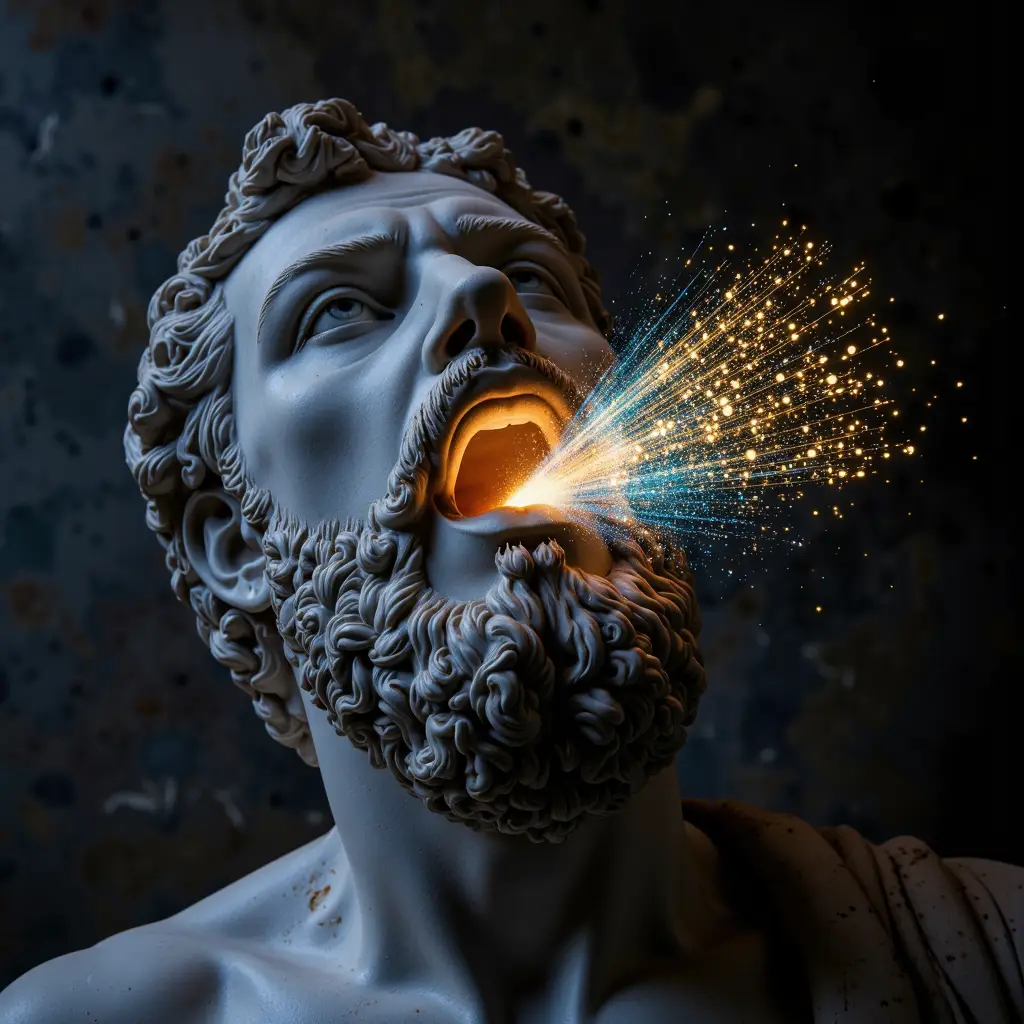
 A seventeenth-century sculpture in the gardens of Versailles takes a breath and begins to tell its own story. It is not the plot of a fantasy novel, but the concrete result of a collaboration between artificial intelligence, cultural institutions, and technological platforms. This single episode condenses a question that runs through the entire artistic ecosystem today: when technology becomes the intermediary between artwork and audience, who really controls the narrative?
The thesis I intend to develop is that we are witnessing a profound redefinition of narrative authority in the art world. On the one hand, tools like generative AI, augmented reality, and digital video multiply the channels through which an artwork can be told. On the other hand, the traditional market continues to celebrate the economic value of the physical object with dizzying figures. In between, artists and communities claim the right to participate in the construction of meaning. The result is a field of forces in which technology, market, and social participation vie for the privilege of giving voice to art.
When Machines Become Guides: AI and Avatars Serving Heritage
The project realized by Ask Mona, the Palace of Versailles, and OpenAI represents an emblematic case. The sculptures of the gardens, mute for centuries, acquire a voice generated by artificial intelligence that transforms a walk into a dialogue (Source 1). The visitor no longer reads a static label: they listen to a modulated, potentially personalized story, born from the intersection of historical data and language models.
However, this operation raises a crucial question. The voice the visitor hears belongs neither to the original artist nor to a flesh-and-blood art historian. It is the product of an algorithm trained on massive amounts of text. Consequently, the interpretive filter shifts from the human expert to the machine, with all that this entails in terms of accuracy, nuance, and cultural responsibility.
A parallel signal comes from Apple’s acquisition of the team and patents of Animato, a startup specializing in three-dimensional AI avatars (Source 5). Animato had created Call Annie, an app that paired digital faces with AI-generated conversations for educational purposes. Apple’s interest suggests that realistic AI-driven avatars could soon populate devices like the Vision Pro, offering virtual museum guides capable of sustaining face-to-face dialogue with the visitor.
Together, these two developments outline a future in which cultural intermediation increasingly passes through digital entities. The question is not whether this will happen, but what criteria will govern the quality and ethics of these artificial narratives.
Glasses and Screens: Augmented Reality Redraws Exhibition Space
If AI provides the voice, augmented reality promises to provide the eyes. XREAL has confirmed the global launch in 2026 of Project Aura, the first AR glasses based on Google’s Android XR operating system (Source 2). This is not a laboratory prototype: the device was presented on the Google I/O stage, signaling a clear intention to reach the consumer market.
Google also announced the Android XR Developer Catalyst Program, an initiative that will distribute development kits to selected developers, providing tools and resources to build native AR applications (Source 7). This program is decisive because it determines who will have early access to the platform and, consequently, which cultural experiences will be designed first.
Imagine wearing these glasses during a museum visit: contextual information, historical reconstructions, and interpretive layers could overlap with the real artworks. Yet, this very overlap risks replacing the personal gaze with a pre-packaged one. Technology that enriches can also saturate, reducing the space for the visitor’s autonomous interpretation.
The Voice of Communities and the Power of Video Storytelling
Against the risk of a narrative entirely delegated to algorithms, some museums choose an opposite path: returning the floor to the people. The Great North Museum: Hancock, in collaboration with Beacon Films, has initiated a process of digital co-production in which local communities actively participate in the construction of the collections’ meaning (Source 3). This is not simple consultation: participants help decide what to tell and how to do it.
This approach overturns the traditional hierarchy. The museum is no longer the sole repository of knowledge; it becomes a platform that amplifies plural voices. Furthermore, the digital format allows reaching audiences who will never cross the institution’s physical threshold, democratizing access to culture.
A complementary model comes from the National Gallery of Art in Washington, which built a multi-platform video strategy around the exhibition dedicated to Elizabeth Catlett, articulated through documentaries, time-lapse footage, and digital installations (Source 4). The exhibition thus transformed into a living organism, capable of existing simultaneously inside and outside the museum’s walls. The video, in this case, is not a simple promotional tool but an autonomous narrative language that extends the reach of the artwork.
Both cases demonstrate that the most effective technology is not necessarily the most spectacular. Sometimes an open camera and microphone to the community produce a deeper cultural impact than a sophisticated language model.
The Physical Market Resists: Record Auctions and Art in Public Space
While the digital advances, the physical art market shows no signs of yielding. Sotheby’s evening auction in New York totaled $303.3 million, driven by a bidding battle for Matisse’s La Chaise lorraine, which sold for $48.4 million (Source 6). Robust results for Picasso, Van Gogh, and Giacometti also confirm that traditional collecting continues to thrive.
This datum might seem contradictory to the push towards digital democratization. In reality, the two phenomena coexist and feed off each other. Video strategies and AR experiences increase the visibility of artists and institutions, generating a halo effect that also supports the economic value of physical works.
On the opposite end of the economic spectrum, artist and game designer Danielle Brathwaite-Shirley will bring her creative vision to a mini-golf course in Battersea, London, designing the ninth hole of a publicly accessible artistic route (Source 8). It is an example of art in public space that challenges conventions: the game becomes an aesthetic vehicle, fun intertwines with reflection, and access is immediate, without an entrance fee or digital filter.
These two extremes—the million-dollar auction and the artist’s mini-golf—remind us that the value of art is not measured by a single metric. Technology adds layers of meaning, but it does not erase the power of the tangible object or the force of bodily experience.
Conclusion: A Narrative to Negotiate, Not Delegate
The analysis of these sources reveals an ecosystem in which the ability to tell the story of art has itself become a contested terrain. Artificial intelligence gives voice to the sculptures of Versailles, Animato-derived avatars promise always-available virtual guides, and AR glasses from XREAL and Google prepare to overwrite reality with unprecedented layers of information.
Yet, the most significant experiences remain those in which technology does not replace the human but empowers it: the community co-production of the Great North Museum, the video strategy of the National Gallery, even Brathwaite-Shirley’s mini-golf. The auction market, for its part, demonstrates that no digital revolution has yet dented the desire to possess the original work.
The challenge for the art world is therefore not to choose between analog and digital, between algorithm and human curator. It is rather to build a balance in which every voice—artificial, communitarian, institutional, mercantile—finds its own space without silencing the others. Who will narrate the art of the future will not be a single technology, but the quality of the negotiation between all these forces.
References:
- When Sculptures Speak: How AI Gave a Voice to the Gardens of Versailles – MuseumNext
- First AR Glasses Running Android XR Confirmed for 2026 Launch – Road to VR
- Who Gets to Tell the Story? Co-Producing Digital Meaning in Museums – MuseumNext
- How the National Gallery of Art Used Video to Take an Exhibition Beyond Its Walls – MuseumNext
- Apple Acquires Key Talent & Patents Behind AI Avatar Company ‘Animato’ – Road to VR
- Bidding battle for Matisse leads Sotheby’s $303.3m Modern art evening sale – The Art Newspaper
- Google Announces New Android XR Developer Program with AR Glasses Dev Kits – Road to VR
- Hole in one: artist-designed mini golf course heads to London – The Art Newspaper
This essay was generated using an artificial intelligence workflow designed and supervised by Enzo Gentile. The sources were automatically selected and analyzed, and the final text was critically reviewed before publication.