
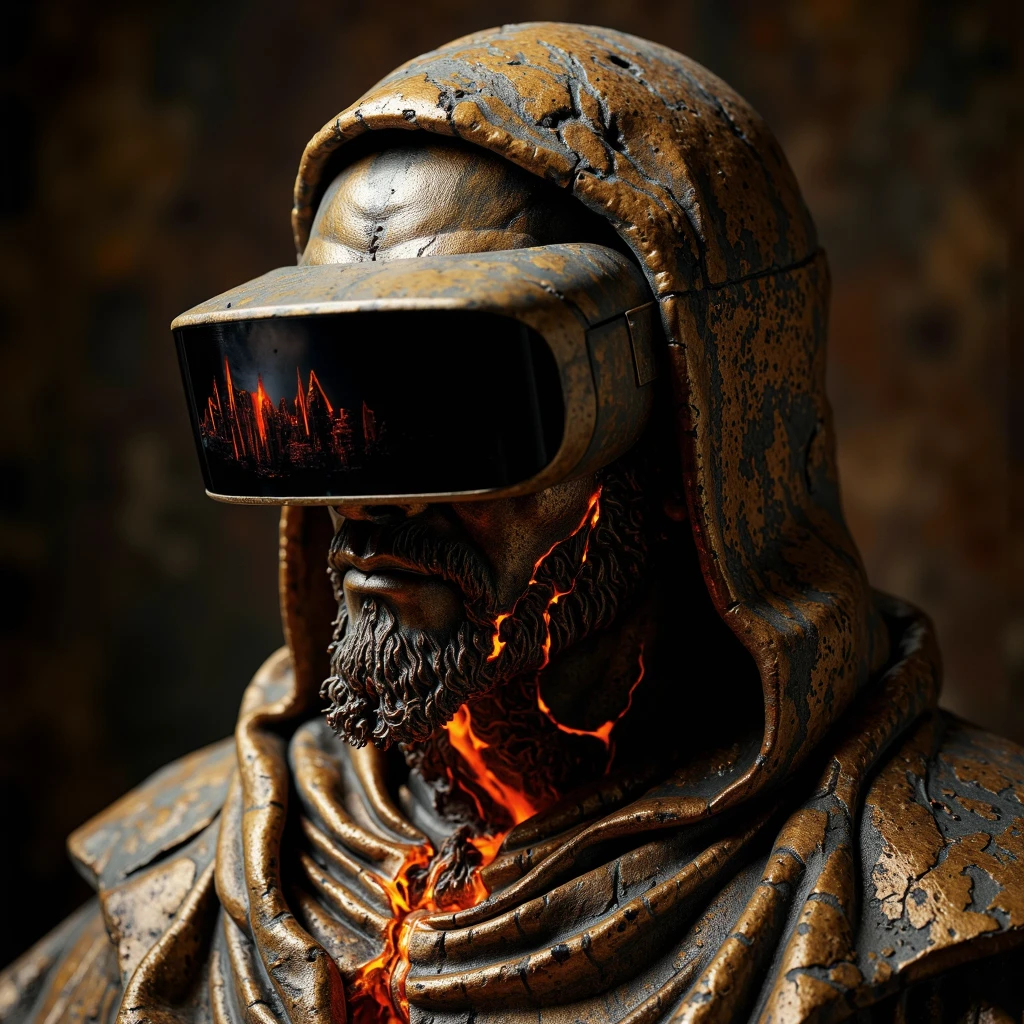
 Can a virtual reality video game set in a galaxy far, far away be considered an artistic experience? The question is not rhetorical. The recent massive discounts on Star Wars VR experiences, launched for May The Fourth (Source 1), reveal something deeper than a simple commercial operation: they show how a narrative universe is migrating towards expressive forms that challenge the traditional boundaries between entertainment, interactive design, and digital art.
The thesis I intend to develop is this: virtual reality experiences tied to cultural franchises like Star Wars represent a laboratory where cinematic language, environmental sculpture, and the bodily participation of the spectator converge, redefining what we call aesthetic fruition.
The Franchise as an Aesthetic Ecosystem
Star Wars has never been just cinema. Since its inception in 1977, George Lucas’s project has functioned as a system of total world-building: orchestral soundtracks, visionary industrial design, concept art that has influenced generations of illustrators.
Every spaceship, every alien landscape, every costume is the result of precise aesthetic choices, often derived from recognizable artistic movements—from futurism to the romantic painting of Caspar David Friedrich for the panoramas of Tatooine.
When this visual heritage is transposed into VR environments, something radically new happens. The spectator no longer observes a painting or a screen: they enter inside it. The Star Wars VR experiences, available today at heavily reduced prices as highlighted by the May The Fourth promotion (Source 1), offer exactly this possibility: to physically inhabit a universe that until yesterday was confined behind a two-dimensional surface.
Virtual Reality as an Artistic Medium
Reducing VR to a gaming technology means ignoring a cultural transformation already underway. Artists like Laurie Anderson and Marina Abramović have explored virtual reality as a space for installations and performances. Museums like the Louvre have commissioned immersive experiences.
In this context, VR titles tied to Star Wars occupy a hybrid and therefore interesting position. They are not art in the institutional sense of the term, but neither are they simple consumer products. They are environments designed with obsessive care for visual, auditory, and spatial detail.
Consider Vader Immortal, one of the experiences likely included in the discounts highlighted by Source 1. The player moves through Darth Vader’s fortress on Mustafar, an environment that is pure emotional architecture: glowing lava, gothic structures, oppressive darkness. The art direction is no less sophisticated than that of a site-specific installation.
However, there is a crucial difference. The traditional art installation maintains a contemplative distance. VR abolishes it. The spectator’s body becomes part of the work, and this raises profound questions about the very nature of the aesthetic experience.
The Price of Access and the Democratization of Art
There is an aspect of the news reported by Source 1 that deserves critical attention: the very fact that these experiences are being offered at steep discounts. The democratization of access is a central theme in the debate on digital art.
Historically, immersive art—from Baroque Wunderkammer to teamLab installations—has been tied to specific physical locations and high consumption costs. Domestic VR overturns this paradigm. With a headset and a few dozen euros, anyone can traverse worlds built with cinematic ambition.
Consequently, promotions like that of May The Fourth are not just marketing strategies. They are cultural distribution mechanisms that lower the barrier to entry for complex aesthetic experiences. This poses an uncomfortable question to the art world: if millions of people experience more intense aesthetic emotions in a VR headset than in a gallery, who decides what is art and what is not?
The Risk of Spectacularization
It would be naive, on the other hand, to ignore the limits of this phenomenon. Star Wars VR experiences remain commercial products designed to maximize emotional engagement and brand loyalty. Their primary function is economic, not critical.
Furthermore, immersive spectacularization risks replacing reflection with sensory stimulation. Art, in its most demanding sense, does not limit itself to making you feel something: it forces you to think something. Commercial VR, instead, tends to prioritize immediate impact over interpretive complexity.
And yet, this very tension makes the phenomenon worthy of analysis. The boundary between art and entertainment has never been a clear line, and VR makes it even more porous.
Conclusion: Beyond the Galaxy Far, Far Away
The discounts on Star Wars VR experiences for May The Fourth (Source 1) are, on the surface, market news. But beneath that surface stirs a cultural issue of broader scope: virtual reality is redefining the relationship between body, space, and visual storytelling, and the great franchises of pop imagination are the terrain on which this redefinition occurs most evidently.
It is not a matter of proclaiming that Vader Immortal is the equivalent of a Rothko canvas. It is about recognizing that the categories with which we think about aesthetic experience are in motion, and that ignoring what happens inside a VR headset means giving up understanding a significant part of contemporary sensibility. Art, after all, has never waited for the institutions’ permission to reinvent itself.
References:
This essay was generated using an artificial intelligence workflow designed and supervised by Enzo Gentile. The sources were automatically selected and analyzed, and the final text was critically reviewed before publication.