
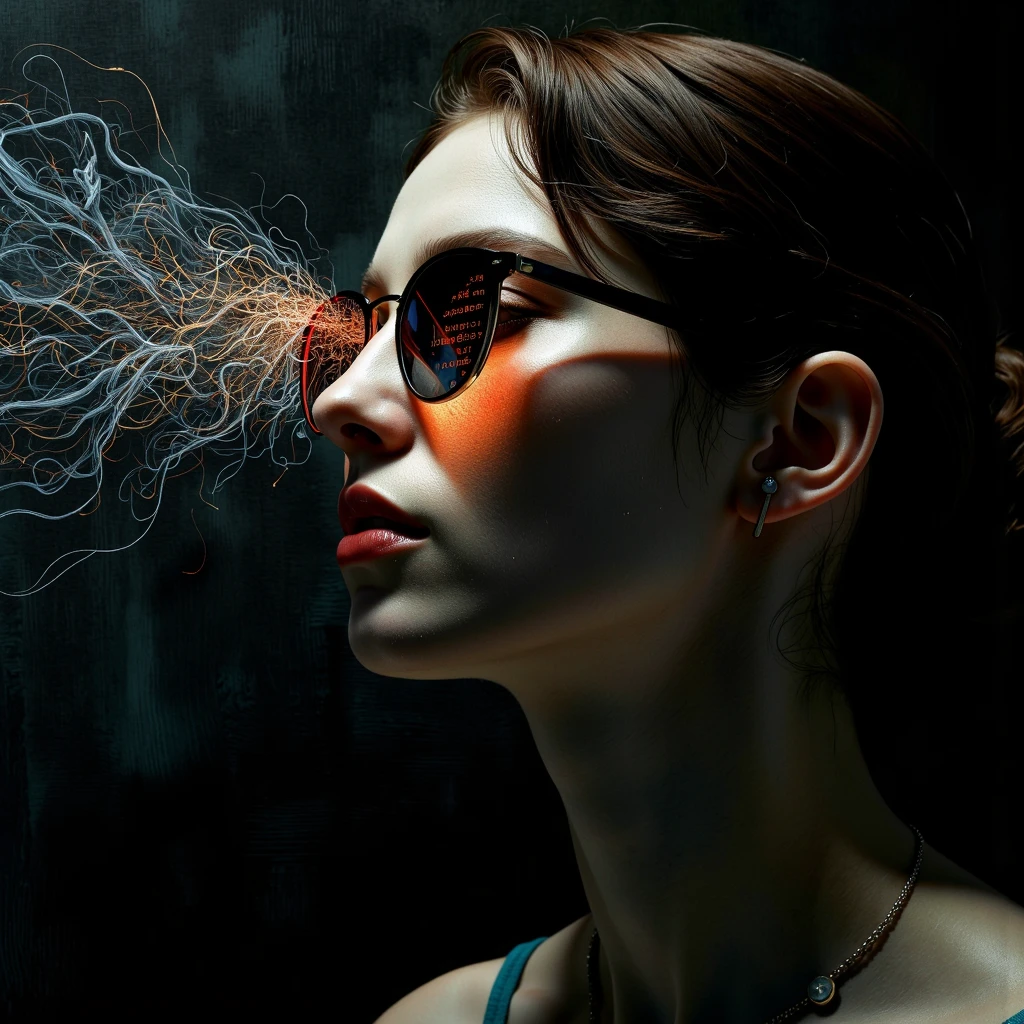
 What happens when an artist’s deepest intimacy confronts the immersiveness of new technologies? Tracey Emin’s retrospective at Tate Modern raises questions about the nature of artistic confession just as devices like Meta’s Ray-Ban glasses and VR scent generators redefine the boundaries of sensory experience.
Contemporary art oscillates between two seemingly opposite poles: on one hand, brutally personal expression, and on the other, technological immersion that amplifies our senses. Yet, both directions share a fundamental goal: breaking down the barriers between creator, work, and audience.
Radical Intimacy as an Art Form
Tate Modern is currently hosting the largest retrospective ever dedicated to Tracey Emin, an artist who has made her private life—including her deepest traumas—the primary material of her work. Her art represents perhaps the most radical form of confession in the contemporary British art scene.
This approach finds a surprising parallel in the drawing tradition of Lucian Freud, whose work is currently exhibited at the National Portrait Gallery in London. The exhibition highlights how drawing was at the heart of his artistic practice, revealing a lesser-known aspect of his work.
Both artists, albeit with different techniques, share an expressive vulnerability that transforms the creative act into a form of personal revelation. It is not simply about representing, but about exposing parts of oneself that are normally hidden.
Technology as Sensory Extension
On the opposite side, we are witnessing an explosion of technologies that amplify and transform sensory experience. Meta’s Ray-Ban smart glasses tripled their sales in 2025, reaching over 7 million units sold. These devices are not simple accessories but extensions of our perceptual capabilities.
Even more revolutionary is the Scentient device, which introduces the sense of smell into virtual reality experiences. This innovation represents a decisive step towards immersive multisensory experiences involving not only sight and hearing but also smell, traditionally excluded from the digital world.
The developer community is also expanding the functionalities of these devices. The open-source project ClawdBot, for example, allows Ray-Ban Meta glasses to identify objects simply by looking at them, transforming the gaze into a powerful tool for interaction with the world.
New Spaces for Expression and Fruition
As immersive technologies become more accessible—as demonstrated by Walmart‘s offer proposing the Quest 3S headset for just $250 with Batman: Arkham Shadow included —traditional art spaces are also reinventing themselves.
In Paris, the museum dedicated to the Romantic movement reopened precisely on Valentine’s Day, celebrating that period through art, music, and soundscapes. The former home of painter Ary Scheffer thus becomes a hybrid space where different sensory forms merge to create a richer and more layered experience.
In this context of transformation, initiatives like the European Media Art Platform (EMAP) play a crucial role, inviting artists and collectives working with digital art, robotics, and bioart to participate in production residencies. These programs facilitate experimentation at the intersection of traditional art and new technologies.
Towards Augmented Sensoriality
The convergence between the radical intimacy of artists like Emin and new immersive technologies is not accidental. Both respond to a deep desire to overcome the limits of traditional representation to create more authentic and engaging experiences.
Meta’s smart glasses, with their ability to capture and share personal moments, can be seen as a technological extension of the confessional impulse that animates Emin’s work. Similarly, olfactory devices like Scentient amplify the sensory dimension of art, traditionally limited to the visual.
This evolution raises fundamental questions: what does it mean to be vulnerable in the digital age? How does the artistic experience change when all our senses are involved? And above all, what will be the role of the artist in a world where technology can generate increasingly immersive experiences?
The answer seems to lie in a new form of augmented intimacy, where technology does not replace but amplifies the human capacity to express oneself and connect emotionally.
Conclusion: Art as a Sensory Bridge
Contemporary art, both in its most traditionally expressive form and in its technological incarnations, is redefining the very concept of aesthetic experience. It is no longer just about looking at a work, but about living it through multiple sensory channels.
Tracey Emin’s retrospective at Tate Modern and innovations like Scentient represent two sides of the same coin: attempts to overcome the barriers between artist and audience, between work and spectator, between representation and reality.
In this rapidly evolving landscape, art becomes a sensory bridge connecting deeply intimate human experiences with increasingly sophisticated technological possibilities. It is no longer just a question of what we see, but of what we feel, smell, and ultimately, how we live the artistic experience with our whole being.
References:
- Tracey Emin: ‘I’ve done more in my last five years than in the whole rest of my life’
- Meta Sold Over 7 Million Smart Glasses Last Year, Effectively Tripling Sales in 2025 Alone
- Hands-on with Scentient: feel the perfume of VR!
- Ray-Ban Smart Glasses Get Massive Utility Boost with Cool (but risky) ClawdBot Hack
- London show highlights how drawing was at the heart of Lucian Freud’s practice
- Quest 3S On Sale For $250 With Batman: Arkham Shadow Again At Walmart
- Museum dedicated to the Romantic movement reopens in Paris on Valentine’s Day
- EMAP Residencies 2026 – Open Call
This essay was generated using an artificial intelligence workflow designed and supervised by Enzo Gentile. The sources were automatically selected and analyzed, and the final text was critically reviewed before publication.