
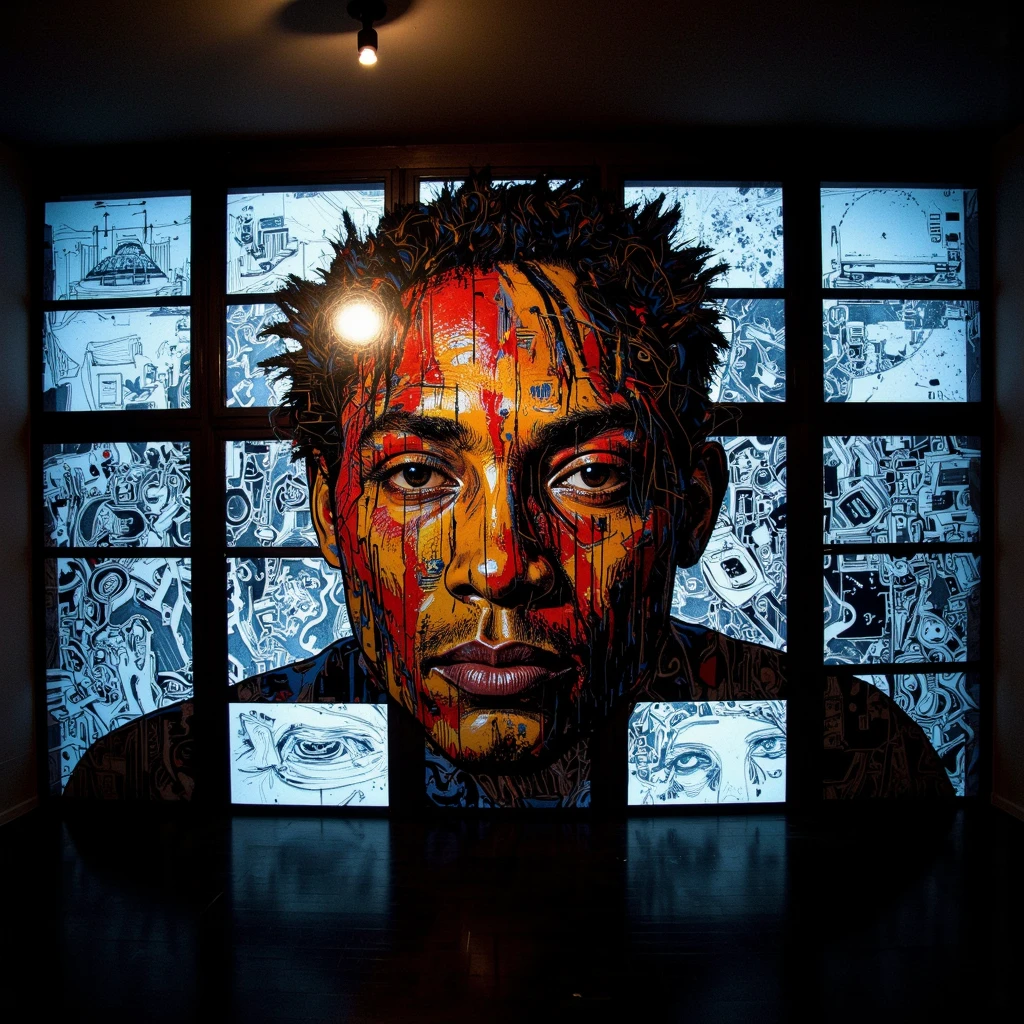
 The rediscovery of forgotten works and the emergence of new expressive forms through technology are redefining the boundaries of contemporary art. When the Louisiana Museum of Modern Art presents Basquiat’s drawings of human heads that remained in the shadows during his lifetime, while Kameron Neal wins a prestigious award for a video work created with surveillance footage, we witness a significant phenomenon: art is re-examining the past through the lenses of the technological present, giving voice to submerged stories and creating new expressive languages.
This intersection between historical recovery and technological innovation is not accidental, but represents a response to contemporary social tensions. Today’s artists seem engaged in a dual process: bringing to light silenced voices of the past and experimenting with new technological means to address current challenges, creating a temporal bridge that connects different eras and sensibilities.
The recovery of submerged voices: a political act
The exhibition dedicated to Jean-Michel Basquiat’s drawings of human heads at the Louisiana Museum of Modern Art (Source 1) represents more than just a simple display. It reveals works that remained largely invisible during the artist’s life, performing an act of historical and artistic justice.
In parallel, the rediscovery of a portrait by Sofonisba Anguissola, a prominent female figure of the Renaissance (Source 5), testifies to a similar phenomenon: the recovery of artistic voices marginalized by the dominant historical narrative.
This process of rediscovery takes on an explicitly political dimension in the work of Kameron Neal, winner of the Outwin Boochever Portrait Competition 2025 (Source 7). Using NYPD surveillance footage from the 60s and 70s, Neal transforms archival materials into a work that questions the history of surveillance and control of African American communities.
The retrospective dedicated to Theresa Hak Kyung Cha at the Berkeley Art Museum (Source 8) also fits into this vein, seeking to present a more complete vision of the Korean-American conceptual artist’s practice, whose multiple creative voices have often been reduced to partial interpretations.
Technology as a new artistic language
If the recovery of submerged voices represents one pole of this artistic dialectic, the other is constituted by the exploration of new expressive territories through technology. The installation by Tarek Atoui at the Turbine Hall of the Tate Modern (Source 2) exemplifies this trend, merging sound, technology, and sculpture to create an experience that transcends the traditional boundaries of artistic media.
His practice, which mixes innovative musical performances with advanced sound technologies, demonstrates how technological tools can become vehicles for addressing contemporary social, historical, and political realities, creating immersive experiences that engage the audience on multiple levels.
This approach finds an echo in the reflections on virtual reality contained in Source 6. The lessons learned from the creation of “Bootstrap Island” reveal how the construction of immersive VR worlds requires not only technical skills but also a deep understanding of human experience and modes of interaction with digital environments.
The debate on artificial intelligence documented in Source 4 adds a further layer to this exploration. The perspectives of tech leaders, journalists, and students on the promises and perils of AI suggest that we are at a crucial moment of defining the relationship between human creativity and algorithmic assistance.
Art as resistance and responsibility
The return of Ai Weiwei to China after ten years of exile (Source 3) illuminates a third fundamental aspect: art as an act of resistance and civic responsibility. The Chinese artist’s path, characterized by a constant confrontation with power systems, represents a model of artistic practice that does not shy away from the political implications of its work.
His new exhibition at MAXXI L’Aquila fits into this trajectory, demonstrating how art can serve as a space for criticism and reflection on the relationships between the individual, society, and power structures, regardless of the medium used.
This political dimension of contemporary art also finds resonance in the work of Neal (Source 7), who reuses surveillance materials to create a visual commentary on the dynamics of social control, and in the sound installations of Atoui (Source 2), which refer to current social and political realities.
Contemporary art therefore seems to assume a role of critical testimony, using both the recovery of submerged voices and technological innovation as tools to question the present and imagine alternative futures.
Towards an art of temporal connections
What emerges from the analysis of these diverse artistic practices is a tendency to create temporal connections that challenge the linearity of historical narrative. The rediscovery of forgotten works by Basquiat or Anguissola is not a simple act of archaeological recovery, but a way to re-read the past in light of contemporary sensibilities.
At the same time, the use of advanced technologies like AI, VR, or interactive sound installations does not represent a headlong rush forward, but an attempt to create new languages to articulate concerns deeply rooted in the human condition.
This dialectic between recovery and innovation, between memory and experimentation, constitutes perhaps the most distinctive characteristic of contemporary art in an era of technological acceleration and critical revision of historical narratives.
The work of artists like Ai Weiwei, Tarek Atoui, and Kameron Neal demonstrates that the most vital art of our time is that capable of inhabiting this productive tension, using the tools of the present to re-read the past and imagine possible futures.
The challenge for museums, galleries, and cultural institutions will be to create spaces that can welcome and value these hybrid practices, which cross temporal, geographical, and disciplinary boundaries, giving life to a continuous dialogue between submerged voices and emerging technologies.
References:
- Denmark exhibition invites visitors to come face to face with Basquiat’s ‘head’ works
- Tarek Atoui—known for his innovative musical performances—will take over Tate Modern’s Turbine Hall this autumn
- The return of Ai Weiwei: from China to L’Aquila, between art, power, and responsibility
- Where Tech Leaders and Students Really Think AI Is Going
- Rediscovered portrait by the Renaissance’s leading woman artist goes on display at the Winter Show
- 5 Lessons from Building ‘Bootstrap Island’: Best Practices for Creating Truly Immersive VR Worlds
- US National Portrait Gallery reveals winner of its triennial portraiture award
- Conceptual artist Theresa Hak Kyung Cha’s gets expansive tribute in California show
This essay was generated using an artificial intelligence workflow designed and supervised by Enzo Gentile. The sources were automatically selected and analyzed, and the final text was critically reviewed before publication.